innovation

Best restaurant apps to grow customer loyalty

Every restaurant owner aims to grow their restaurant’s revenue, but not all achieve success. The reasons behind these ups and downs can vary, from managerial skills to external factors like location and global crises. 

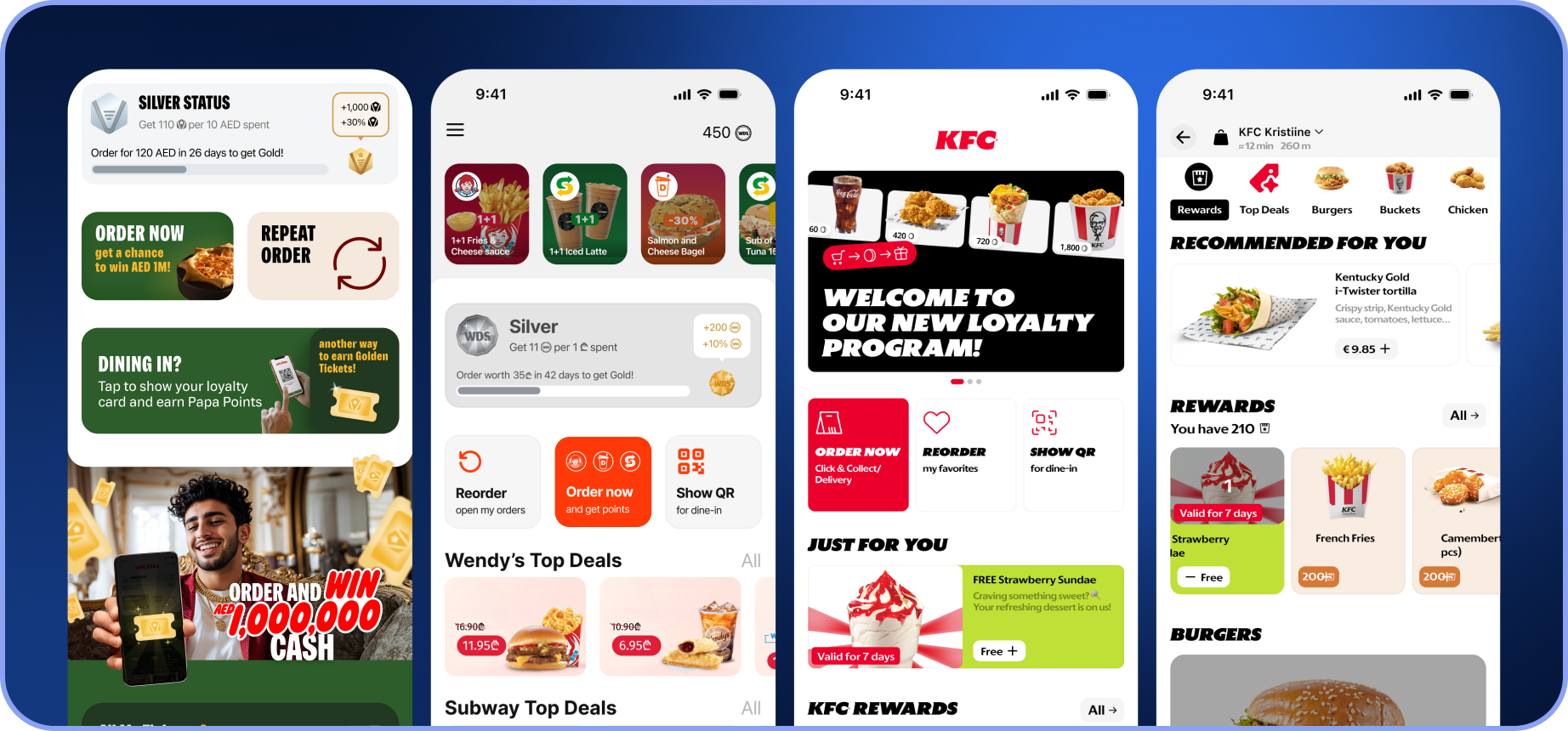
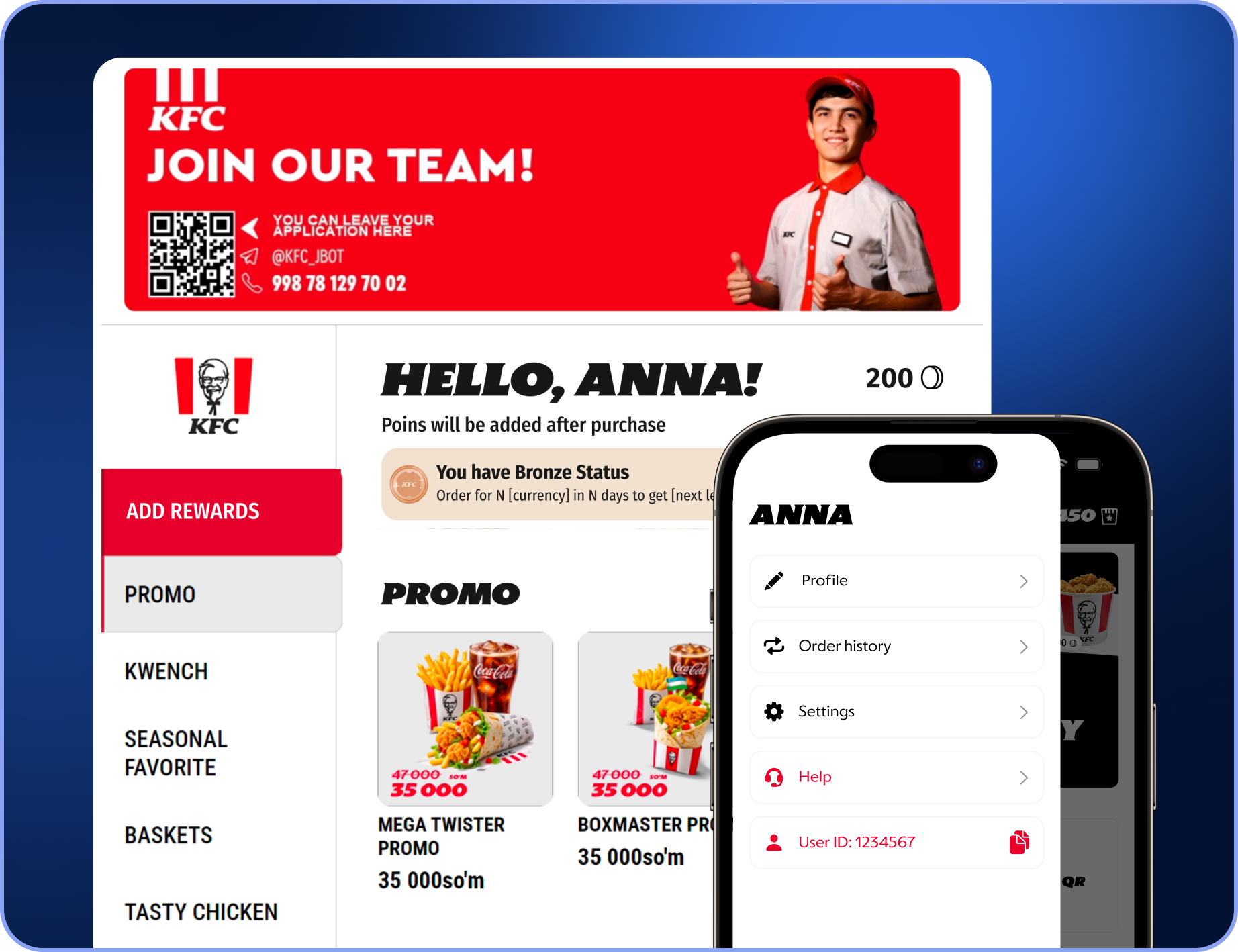
One thing is clear: for sustained growth, a restaurant needs more than just great food and a well-organized team. A dedicated restaurant app, combined with an effective loyalty program, is no longer optional—it’s essential. In this article, we’ll explore what makes a restaurant app a truly revenue-driving tool.

Recent research shows the rising importance of loyalty programs, with 51% of U.S. consumers using them in restaurants, up from 45% last year. Quick-service restaurants (QSRs) see the highest participation at 49%, while 34% of full-service restaurant (FSR) customers are also engaged. This trend highlights the growing value of loyalty programs for driving customer retention and growth.

Are branded apps and loyalty programs like body and heart?

Many restaurants, when selecting a company to create an app, believe that simply having a well-designed app is enough. However, this is a major misconception. What truly makes your app effective is your loyalty program, and what powers your loyalty program is the app itself.

With that in mind, we’ve identified the five key factors that make your app worth downloading.

Best restaurant apps to grow customer loyalty

Criteria 1: Focus on UI/UX and usability

Having a sleek, stylish app is not enough. The primary focus of the product should always be on the customer experience. Ask yourself: on a scale of 1 to 10, how easy is it for a user to place a new order or reorder their favorite menu items?

Why is this important?

The user’s main goal is to place an order quickly and easily, without any interruptions. Unfortunately, many vendors focus more on adding features than on creating a user-friendly experience.

IT expertise and coding skills alone aren’t enough. A deep understanding of mobile app engagement strategies, user behavior, restaurant app KPIs, and more is critical to ensuring the success and profitability of both the app and your marketing initiatives.

When we download a new app, we’re eager to dive in and start using it. But often, the first thing we encounter is a sign-up screen. 🙄 This can be a major turn-off, as the friction of signing up can drastically reduce user enthusiasm. It’s a common mistake many companies make.

Example:

In the Papa Johns loyalty program, app, and website, we’ve designed a seamless onboarding and activation process without requiring registration upfront, ensuring that no potential guest is lost due to unnecessary complexity.

Additionally, LoyaltyPlant’s Smart landing pages eliminate the need to remember or manually enter promo codes. These landing pages automatically apply offers, further simplifying the user experience and making it effortless for guests to enjoy their bonuses. This frictionless process helps boost user engagement and ensures a smooth journey from start to finish.

Best restaurant apps to grow customer loyalty

Criteria 2. Offer cost-effective gifts to enhance satisfaction

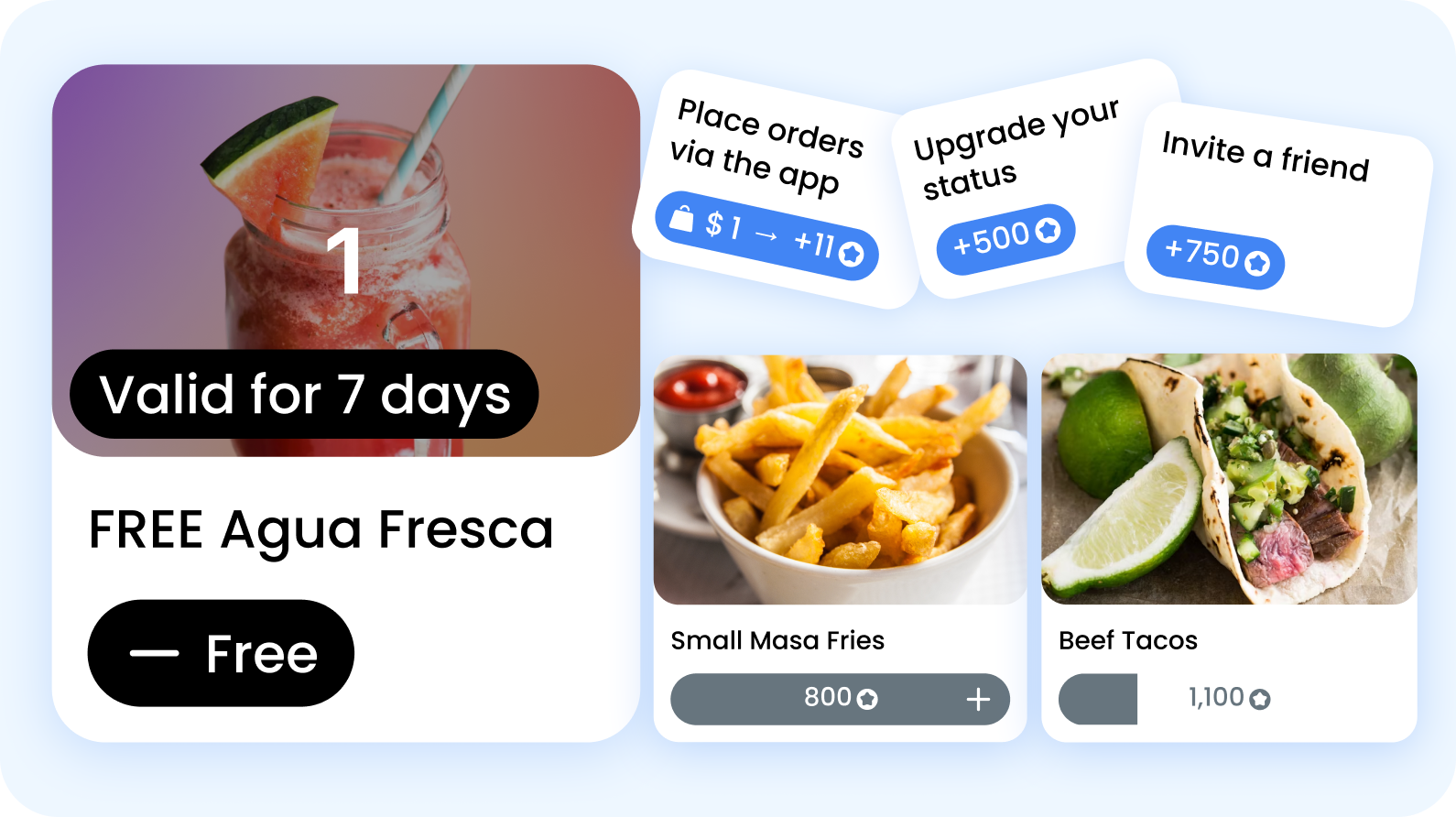
An effective rewards program should focus on reducing promotional costs associated with customer acquisition and retention, while minimizing reliance on discounts. By offering cost-effective gifts, guests can redeem their accumulated rewards for various purposes, such as low-cost menu items based on their loyalty status.

Why is this important?Over-reliance on discounts can erode profit margins and devalue the brand. A well-structured rewards program with low-cost items engages customers and encourages frequent redemptions without reducing the average check size. This strategy not only maintains profitability but also enhances customer satisfaction by adding a sense of joy to every purchase.

Example:LoyaltyPlant aims to boost customer loyalty and engagement without depending heavily on discounts, which could hurt profitability. So, we developed a cost-efficient rewards catalog that provides value to customers while maintaining revenue stability.

  • Low-Cost Menu ItemsEasily redeemable items like potato wedges that complement main dishes, encouraging frequent redemptions.
  • High-Cost RewardsPremium items reserved for higher-tier customers, incentivizing members to reach top-tier status.
  • Charity DonationsPlatinum customers can donate points equivalent to one large pizza. Papa Johns matches this with three additional pizzas, providing meals for families in need.

ResultsDespite the availability of higher-cost rewards, most guests chose to redeem points for low-cost items, resulting in a stable (and sometimes increased) average check size. The new rewards strategy successfully increased customer engagement while supporting revenue growth—proving that a well-structured loyalty program can achieve both customer satisfaction and profitability.

Best restaurant apps to grow customer loyalty

Criteria 3. Use AI to bring more revenue

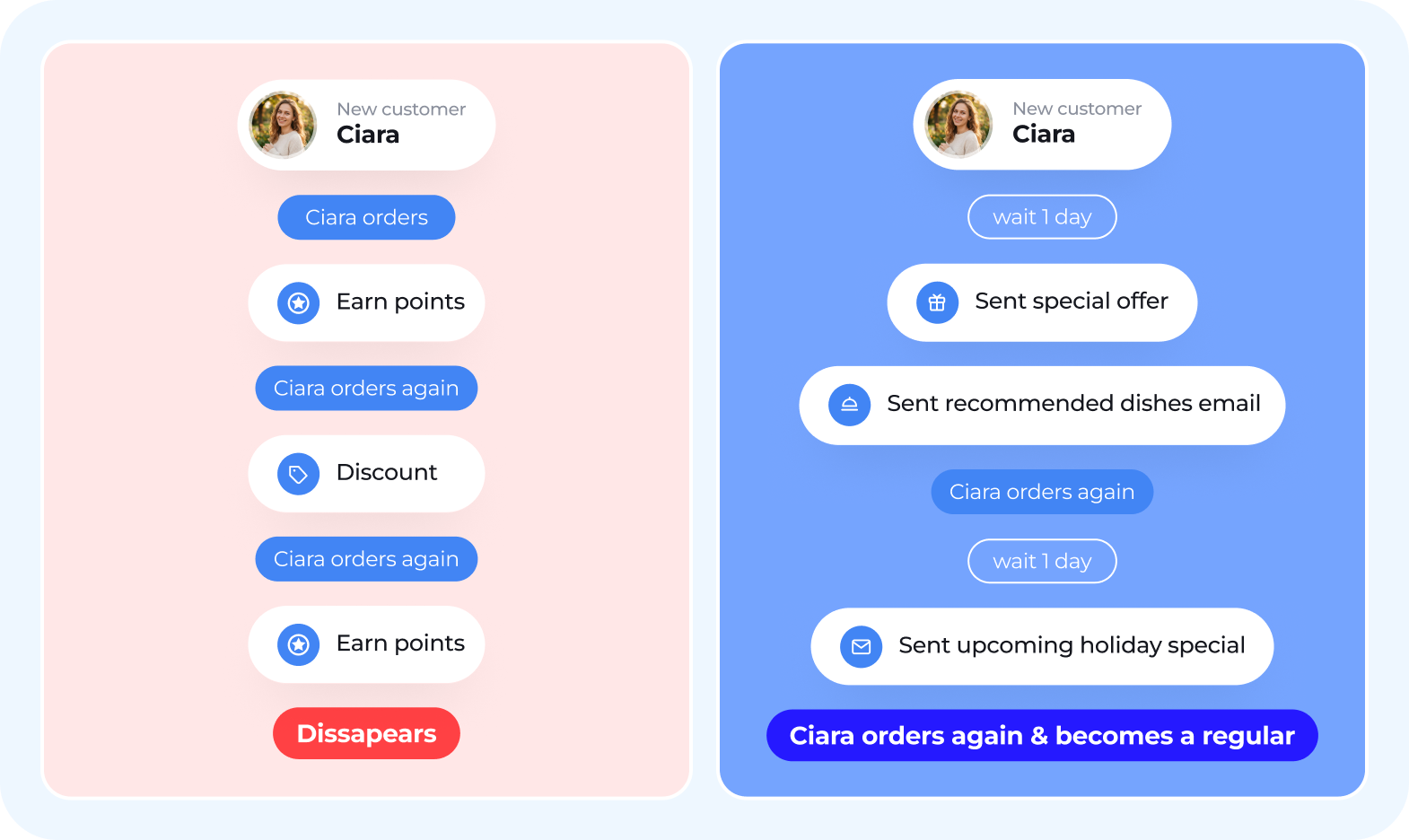
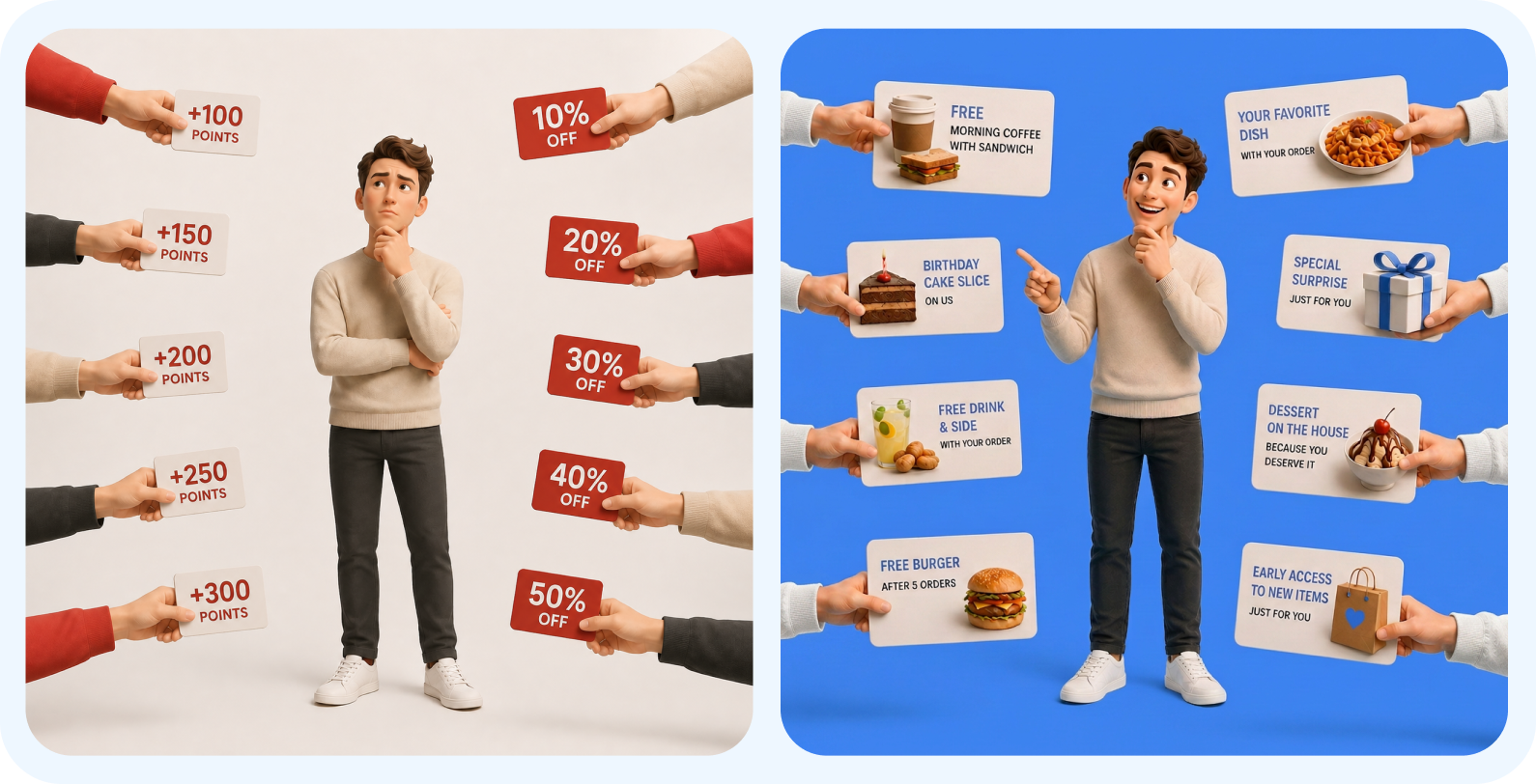
Leveraging AI for personalized campaigns enables brands to create tailored messages based on individual customer preferences, order history, and frequency. By delivering targeted offers at the right moment, such as a favorite dish, AI helps motivate customers to place an order and stay engaged.

Why is this important?

Personalized marketing is far more effective than one-size-fits-all approaches. Generic offers can be overlooked, while tailored messages resonate more with customers, making them feel understood and valued. This leads to increased order frequency, improved customer retention, and overall revenue growth, proving that AI-driven personalization can drive meaningful business outcomes.

Example: 

A key component of Papa Johns’ loyalty strategy is the use of AI-powered personalized campaigns that target customers based on their behavior, preferences, and order frequency. These campaigns aim to deliver the right offer at the right time—whether it’s a free pizza or a special menu item—encouraging customers to place an order within a limited time frame.

The database of Papa Johns guests was segmented into two main categories:

  1. Active Customer Cohorts
  • Heavy Users: 3+ orders per month
  • Medium Users: 2 orders per month
  • Light Users: 1 order per month
  1. Lapsed Customer Cohorts
  • Lightly Lapsed: No orders for 1-2 months
  • Medium Lapsed: No orders for 2-4 months
  • Super Lapsed: No orders for 4-12 months

For example, if a “super lapsed” customer previously showed a preference for Pepperoni pizza, the AI algorithm would send a personalized push notification, such as: “Craving Pepperoni? Get a free slice with your next order!” This targeted message would encourage the customer to return and place an order, reactivating them as an active guest.

Best restaurant apps to grow customer loyalty
5 key questions to ensure your app and loyalty program drive revenue in 2025 🚀
Frame 3991 Download the guide now!

Criteria 4. Gamify experience to grow engagement

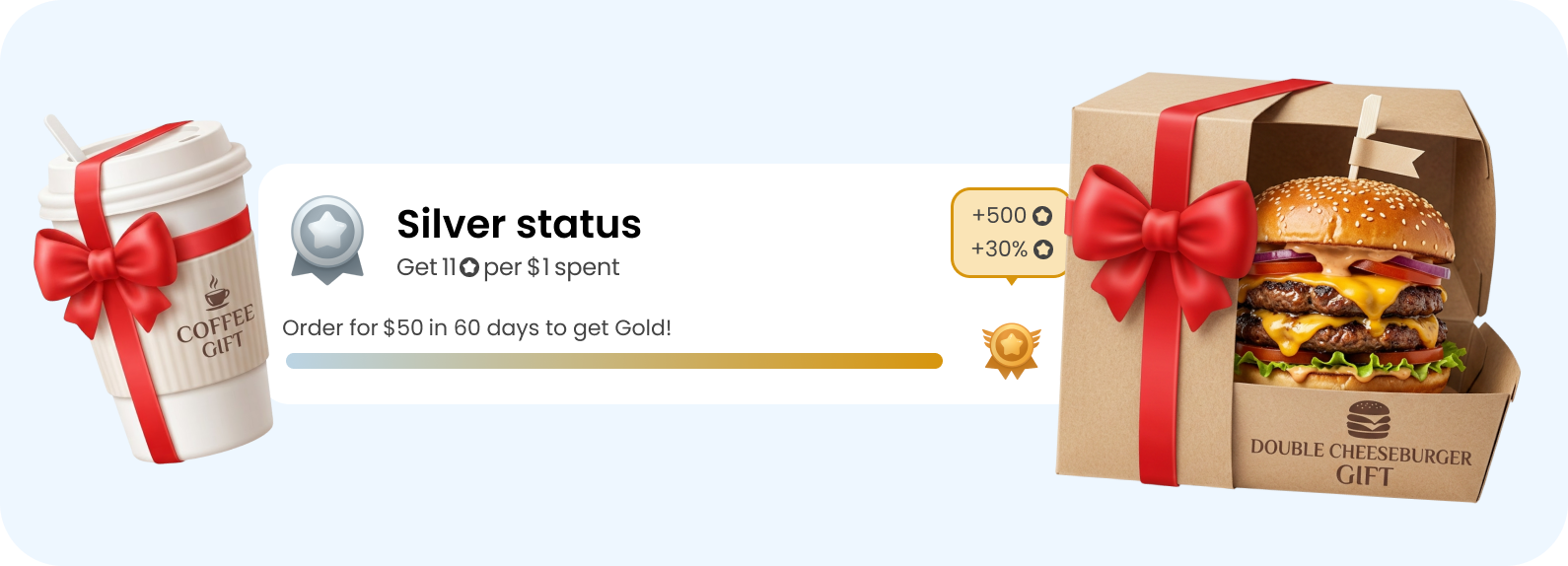
A successful tiered loyalty program should be dynamic and easy to understand, featuring elements like expiring tiers, a visible progress bar, and automated messages about upcoming status changes. These features keep customers informed and motivated to maintain or elevate their tier status.

Why is this important?If a loyalty program is too complicated or static, it can fail to engage customers, especially younger generations who value instant feedback and excitement. By making the loyalty journey visually appealing and straightforward, customers can easily track their progress and feel a sense of accomplishment. This approach not only boosts visit frequency but also enhances the overall user experience and strengthens brand loyalty.

Example:

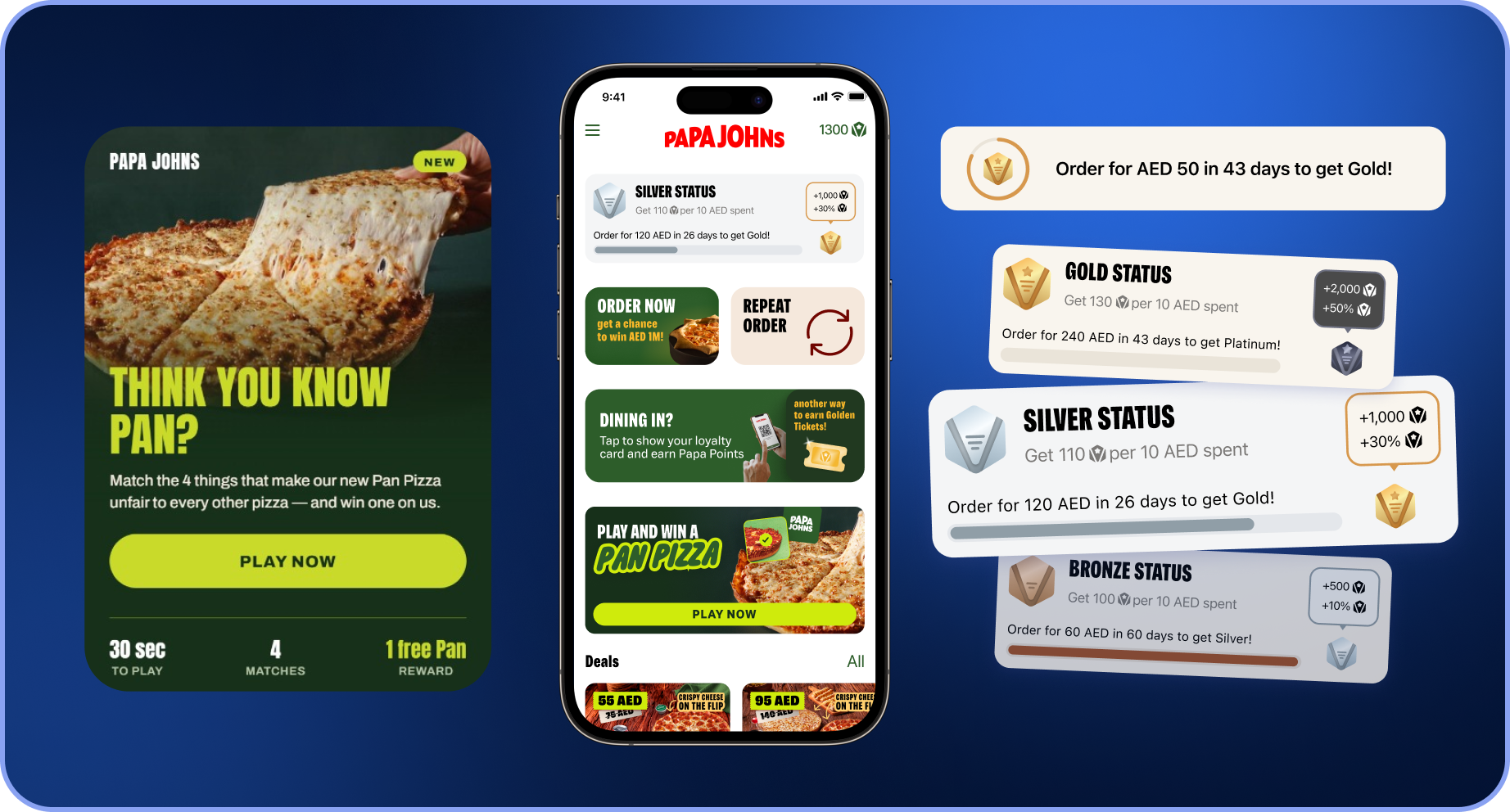
LoyaltyPlant introduced a tiered loyalty program, tailored to enhance customer engagement and revenue growth. The program is structured around four distinct levels, each offering progressively better rewards and motivating customers to move up the tiers.

The tiered structure is visually integrated into the app’s main screen, providing customers with clear goals to reach the next level. Each tier has specific criteria and can be customized to match a brand’s unique features. For example, for Papa Johns UAE, we designed the following four statuses:

  • Bronze StatusAutomatically granted upon downloading the app, offering basic rewards for new users.
  • Silver StatusUnlocks additional benefits like birthday gifts for customers who meet the spending threshold.
  • Gold StatusIncludes higher point accumulation and access to exclusive merchandise.
  • Platinum StatusPlatinum Status Provides VIP perks such as invitations to special events and the option to donate points to charity.

ResultsThis dynamic tiered system not only boosts customer engagement but also encourages increased spending as customers strive to reach higher levels. With the visual progress bar and gamified tier upgrade animations, users interact more frequently. As a result, the program significantly increased average check sizes and customer lifetime value, making it a key contributor to revenue growth.

Best restaurant apps to grow customer loyalty

Criteria 5: Enable seamless integration with delivery platforms

A powerful restaurant app should seamlessly integrate with third-party delivery platforms or offer in-house delivery options to provide a smooth ordering experience.

Why is this important?A lack of integration can lead to fragmented customer experiences, frustration, and missed revenue opportunities. An app that allows customers to place orders, track deliveries, and redeem loyalty rewards in one place provides a cohesive experience and boosts satisfaction.

Example: 

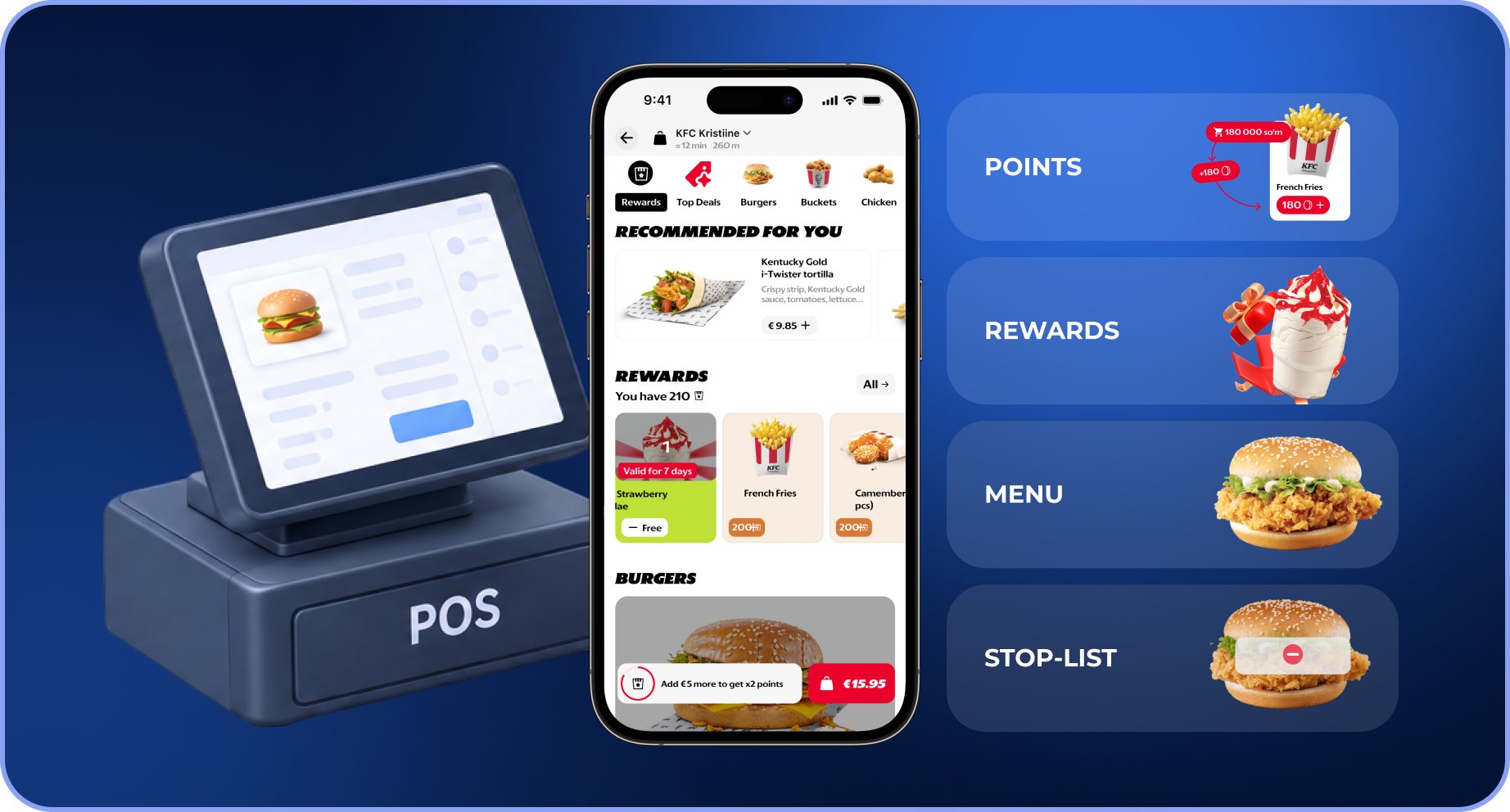
At LoyaltyPlant, we offer integrations with major POS systems like Syrve, ensuring that the entire ordering process is fully automated. All online orders are sent directly to the kitchen, and loyalty points are automatically accumulated and subtracted—both for online and in-store orders (via QR-code scanning). Menu items, stop-lists, and order statuses are synced in real-time with the POS system, minimizing manual errors and reducing fraud risk.

With our solution, rewards are only redeemed after validation, and extended targeting options, such as purchase history targeting, are available thanks to the deeper data integration. All sales, stock inventory, and other operational data are automatically accounted for, creating a seamless experience for both customers and staff. 

Best restaurant apps to grow customer loyalty

Final thoughts

Building a successful restaurant app that drives customer loyalty and revenue growth requires careful planning and implementation of the right features.

Whether it’s focusing on seamless UI/UX, gamifying the experience, or leveraging AI for personalized offers, each criterion plays a critical role in shaping a rewarding customer experience. By incorporating these elements, you can turn a basic app into a powerful marketing tool that transforms casual customers into lifelong brand advocates.

Curious to see if your app and loyalty program are delivering the results you want?

Take the first step towards optimizing your customer engagement strategy
with a free analysis of your app and loyalty program. If you don’t have an app yet, our team can help you explore the benefits of developing one tailored to your needs.

For existing app users, we’ll identify opportunities to enhance your app’s performance, helping you unlock more sales and elevate customer satisfaction. Fill out the form now to get your free analysis from top experts and discover the untapped potential of your restaurant’s digital presence.

LoyaltyPlant at the L&L Hawaii Barbeque 2024 Partner Convention: Success with a Global Brand in Numbers

Recently, LoyaltyPlant attended the annual convention of our partner, L&L Hawaiian Barbecue, in the vibrant city of San Antonio, Texas. The event gathered hundreds of franchisees, suppliers, and managers from across America. During the conference, Evgenia Mkrtychian, our Head of Customer Success from New York, closely engaged with franchisees, discussed upcoming growth plans, and received feedback about LoyaltyPlant. 


LoyaltyPlant has developed a mobile customer engagement platform, comprising a mobile app with in-app marketing and a loyalty program, website, and a CRM system. Currently, more than 137 locations across the USA have been actively using our application for over four years!

LoyaltyPlant at the L&L Hawaii Barbeque 2024 Partner Convention: Success with a Global Brand in Numbers

How it all begun

Let’s rewind to the beginning to grasp the necessity for the digital change of L&L Hawaii Barbeque. Established in the 1950s, the brand has flourished for over half a century, focusing primarily on in-store operations.

However, with the evolution of technology and significant global shifts, the emergence of the online realm has posed a considerable challenge. This challenge has directly impacted the brand’s extensive network, requiring adaptation to this new reality and ensuring seamless functionality across all its locations.

LoyaltyPlant at the L&L Hawaii Barbeque 2024 Partner Convention: Success with a Global Brand in Numbers

Our journey with L&L Hawaii Barbeque commenced four years ago. During this time, we crafted a holistic strategy that seamlessly integrated all critical elements of the mobile customer engagement platform: 

  • a mobile app with in-app ordering    • comprehensive loyalty program with gamification mechanics     • a referral program that brings thousands of dollars in extra profit from new users      • analytics tools that allow to build more efficient campaigns        • CRM system with various marketing modules

LoyaltyPlant at the L&L Hawaii Barbeque 2024 Partner Convention: Success with a Global Brand in Numbers

To provide context for the current situation, we’ve highlighted several showcasing facts that demonstrate how our work has made a difference for businesses in numbers during these 4 years of work with L&L Hawaii Barbeque. 

Here are 4 facts that speak for themselves:

 1. 60% of app users started to order more frequently after installing the L&L Hawaiian Barbecue mobile app.

 2. We’ve launched several brand-wide campaigns aimed at encouraging repeat purchases and stimulating downloads, resulting in revenue growth of over 67% for our targeted menu positions.

 3. Remarkably, 82% of users rated their satisfaction with the L&L app as high, giving it scores between 8 and 10 (the survey was conducted through the mobile app)

 4. Award Recognition: The L&L & LP Case Study garnered acclaim, receiving the prestigious Platinum Award in the Mobile/App Category at the 2023 dotComm Awards, reaffirming our commitment to excellence and innovation. 

Want to Grow Like L&L Hawaiian Barbecue and Even More?

If you’re interested in creating a revenue-increasing mobile application like L&L Hawaii Barbeque’s or want to learn how to grow online ordering volumes in your restaurant chain, leave your contact details here, and our team will assess your business potential and suggest optimal solutions that can drive real revenue growth.

How to choose a restaurant loyalty platform: 7 criteria for 2027

In the UAE, more than 90% of online restaurant sales went through delivery aggregators. For Papa Johns, this meant relying heavily on third-party platforms that owned the guest relationship, the data, and a share of every order.

So the brand built its own direct channel: a branded app with a gamified loyalty program inside. The app gave guests a place to order directly. The loyalty program gave them a reason to come back. Annual sales doubled within two years of the app launch.

That is what a restaurant loyalty platform really does. It is not just points. It is the system behind your own app, your ordering, and your guest relationship. With one in three diners switching favorite QSR brands in a year (PYMNTS), choosing that system is one of the biggest decisions a chain makes.

Here are seven criteria to check before you sign. They follow the order of a real evaluation: first the vendor, then the product, then the results.

1. A proven track record with restaurant brands

Start with the vendor, not the features. Most restaurant loyalty platforms look good in a demo. A track record shows what a platform has already done for brands like yours.

  • Measurable results: documented impact at restaurant chains, such as a large share of sales coming through the brand’s own app and website
  • Experience with leading QSR brands, ideally in competitive markets where guests have many options
  • Proof you can verify: public case studies, industry awards, and reference clients you can call

Questions to ask: Can you share case studies with measurable, client-verified results? How were those results measured, and can we speak directly with a reference client?

How to choose a restaurant loyalty platform: 7 criteria for 2027

2. One guest profile that you own

Once you trust the vendor, look at the product. The first test: does it see your guest as one person, and does that person belong to you?

A guest who orders on your website, visits a store, and opens your app should be one profile with one history, not three strangers in three systems. That is the main advantage of an all-in-one loyalty platform over separate tools, and the basis for personalization, fair rewards, and accurate reporting.

That profile is your most valuable asset. Aggregators keep the data from every order they handle. Your own app wins it back. You should be able to export all your guest data at any time, and bring existing members and points with you when you switch.

Questions to ask: Do all channels, including app, ordering, loyalty, and CRM, use one unified guest profile rather than separate profiles for each channel? Can we export all our customer data at any time? Can you migrate our existing members, points, and loyalty data from our current solution to the new platform?

How to choose a restaurant loyalty platform: 7 criteria for 2027

3. Gamification across the entire guest experience

A unified profile tells you who your guests are. Gamification gives them a reason to come back.

Points-only programs are easy to launch and easy to ignore. If your program is just another discount, you are competing on price. The strongest programs build gamification into every step of the app, not one feature hidden in a menu:

  • Tiers and progress bars that guests want to reach and do not want to lose

  • Missions, mini-games, and seasonal events that give guests a reason to open the app without a discount

  • Referral rewards that turn fans into ambassadors

This matters most for younger guests. In Euromonitor’s Voice of the Consumer: Loyalty Survey, 27% of Gen Z said loyalty programs are “not fun.” For this generation, a program has to feel like a game, not a coupon book.

Questions to ask: Is gamification built into the whole app?

How to choose a restaurant loyalty platform: 7 criteria for 2027

4. POS integration and tech-stack flexibility

Even the best guest experience fails if it does not work in your stores. Your loyalty platform must connect with your point-of-sale (POS) system: points, rewards, menus, and stop-lists all depend on it.

But do not rule out a vendor just because your POS is not on its list yet. Good platforms keep adding integrations, and you may become the first client with yours. What matters is flexibility: open APIs and a team ready to build new connections.

Questions to ask: Which POS, payment, and delivery systems do you support? If ours is missing, can you build the integration?

How to choose a restaurant loyalty platform: 7 criteria for 2027

5. Franchise and multi-location readiness

A platform that works for one store must also work for a hundred. A franchise network has two customers inside one platform. Headquarters needs brand consistency and network-wide reporting. Franchisees need local offers and proof that the program brings guests to their store.

The platform should support both. One location may need its own menu, its own stop-list, or an age check for alcohol. Flexible access levels let regional teams update their own menus and offers within the limits HQ sets, in every language the network uses.

Questions to ask: Can each location have its own menu, promotions, and reporting? Does the platform support all the languages you need, including right-to-left languages?

6. Ongoing support and a dedicated Customer Success manager

With the product checked, look at the team behind it. Software alone does not grow sales. What grows sales is how you use it: which campaigns you run, when, and for which guests.

Look for a dedicated Customer Success manager who knows your brand and KPIs, a partner rather than a ticket queue, who:

  • reviews your numbers and tells you what to improve
  • plans campaigns together with your marketing team
  • trains franchisees and store teams

Support should cover guests, store staff, franchisees, and head office, 24/7, under a written SLA. Strong vendors also monitor every order in real time and fix failures before guests notice.

Questions to ask: Will we have a dedicated Customer Success manager?

How to choose a restaurant loyalty platform: 7 criteria for 2027

7. Transparent ROI measurement, visible in the CRM

The last test brings everything together: can you prove it works? Sign-ups look good in a report, but they do not prove revenue. You need to see what each campaign actually earned.

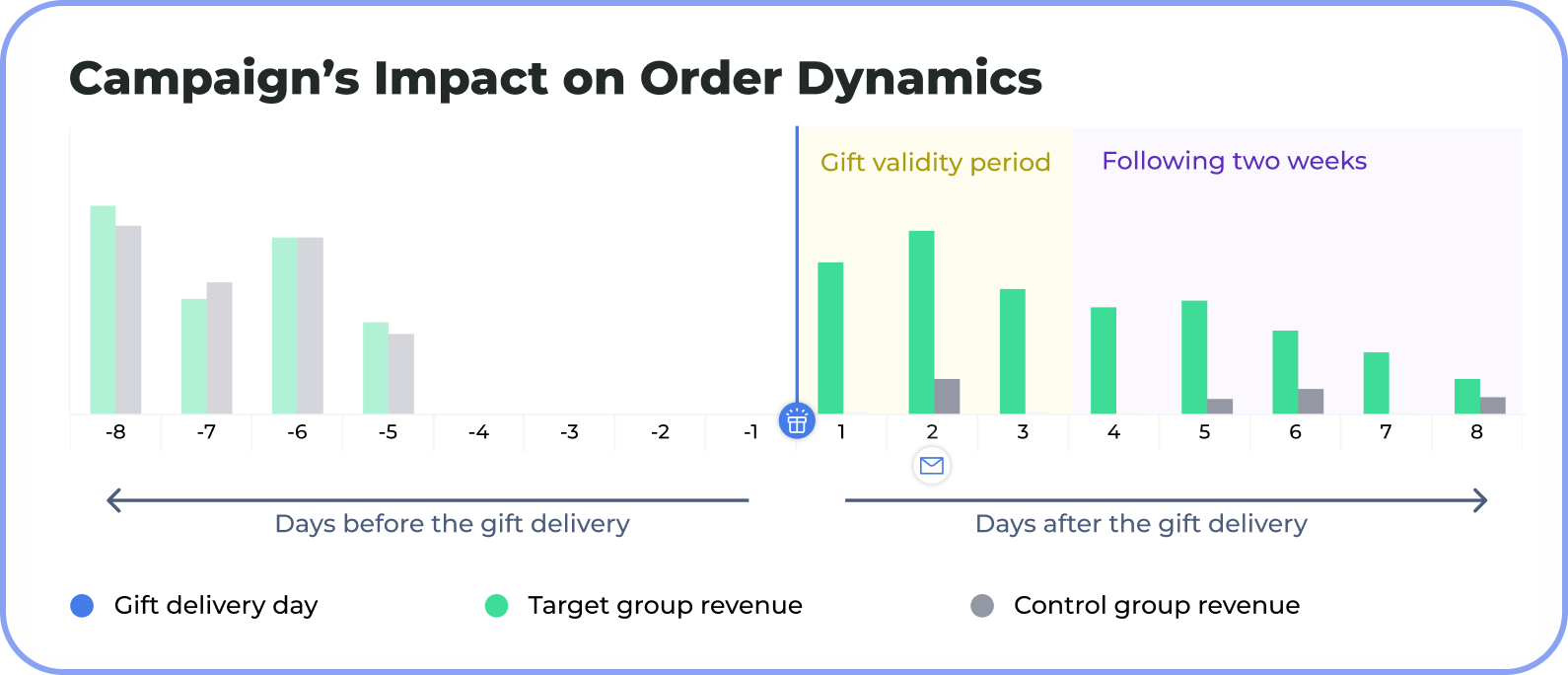
  • Control groups: send an offer to about 80% of the audience, hold back 20%, and compare spending. The difference is the real result, including whether guests keep ordering after the campaign ends.
  • A/B tests: compare two offers, messages, or timings to see which works better.
  • Cohort metrics: active members, visit frequency, retention, and average check for members vs. non-members.

All of this should be visible directly in the CRM, in real time. Then any colleague, from the CMO to a regional manager, can open a campaign and see whether it worked.

Questions to ask: Which ROI methods does the platform support? Can every team member see the results without asking an analyst?

How to choose a restaurant loyalty platform: 7 criteria for 2027

Loyalty program vendor evaluation: 7 questions for every demo

Use this list for any restaurant loyalty software comparison. Bring these questions to every call and score each vendor from 1 to 5, one score per criterion.

  1. Can you show documented results from restaurant brands like ours?
  2. Do the app, ordering, loyalty, and CRM share one guest profile, and can we export all of our data?
  3. Is gamification built into the whole app, and can marketing launch new mechanics without developers?
  4. Which POS systems do you support, and can you build a new integration if ours is missing?
  5. Can each location have its own menu, offers, and reports?
  6. Will we have a dedicated Customer Success manager and a written SLA?
  7. Which ROI methods do you support, and are results visible in the CRM?

How LoyaltyPlant meets these criteria

LoyaltyPlant is an e-commerce and digital customer engagement platform for restaurant chains. Founded in 2016 in New York, we have delivered 600+ projects across 35+ countries, working with brands like KFC, Papa Johns, Wendy’s, Subway, and Dunkin’.

The platform combines a branded mobile app and ordering website, a loyalty and gamification engine, and a CRM with AI-powered marketing. Each client also gets a dedicated growth team focused on its business KPIs.

How LoyaltyPlant meets the 7 criteria for choosing a restaurant loyalty platform
CriterionHow LoyaltyPlant delivers
Track record600+ projects in 35+ countries; standardized rollout across 10+ Papa Johns markets
One guest profile you ownApp, website, ordering, loyalty, CRM, and campaigns share one guest account; data stays in the brand's own CRM; GDPR, ADA, and PCI DSS compliant
GamificationDynamic tiers, missions, badges, mini-games, lotteries, and referrals; ordering and earning without registration
POS and tech stackToast, Square, Clover, Revel, Syrve, POSist, R-Keeper, and more; open APIs; works without a POS
Franchise readinessMenus and stop-lists per store, flexible access levels, multi-language (including Arabic), and multi-brand apps
Customer success and supportDedicated growth team; real-time monitoring and 24/7 support for guests, staff, franchisees, and HQ
ROI measurementControl groups, A/B tests, and incremental profit, visible in real time in the CRM

LoyaltyPlant is the strongest fit for QSR and fast-casual chains and multi-country franchises that want to own the guest relationship. A single restaurant that only needs a digital punch card will likely find a simpler tool more cost-effective.

Choose the platform you will not have to replace

A loyalty platform is not a one-year purchase. Once guests download your app and collect points, switching costs you members, data, and momentum. The wrong choice keeps you renting your guests from aggregators. The right one lets you own the relationship, the way Papa Johns did in the UAE.

Bring this checklist to a 20-minute walkthrough with our team. Book your demo and see, criterion by criterion, how LoyaltyPlant would work for your chain.

KFC Ukraine case study: how a Minions menu became an app experience

Most brand collaborations live in two places: the in-store menu board and a burst of paid social. The app, if it shows up at all, gets a banner. KFC Ukraine’s Minions collaboration did something different. The LoyaltyPlant-powered app became part of the campaign itself, not just a place to announce it. A branded memory game turned into the kind of thing guests shared with friends unprompted, and one limited-edition reward sold out within days.

Here’s what made the difference between a menu launch guests scroll past and one they actively play with.

The problem: limited-time collaborations don't automatically reach the app

Brand collaborations are built for visibility: new packaging, new characters, new social content. They’re not automatically built for interaction. A themed menu can generate impressions without ever giving guests a reason to open the branded app, so the collaboration’s energy stays on the shelf and on social media instead of converting into app engagement or repeat visits.

For KFC Ukraine’s Minions collaboration, the brief was to make the app itself feel like part of the campaign moment, not a separate channel running its own, disconnected promotion.

The mechanic: three connected elements, not one big feature

  • Rather than build a single flashy feature, the campaign combined three simple, connected elements inside the app.
  • A themed limited-time menu, inspired directly by the Minions collaboration, so the in-app ordering experience matched what guests were seeing on the menu board and in marketing.
  • A redesigned home screen that immersed guests in the campaign the moment they opened the app. The first thing a guest saw was the collaboration, not a generic homepage.
  • A branded memory game, where guests matched cards to unlock rewards tied to the new menu. The mechanic was intentionally simple: match pairs, unlock a reward. That simplicity was a deliberate choice, not a limitation. It made the game easy to pick up in seconds while still fitting the campaign’s playful theme.
  • None of the three elements asked guests to do anything unfamiliar. A themed menu, a refreshed homepage, and a matching game are all mechanics people already understand. The campaign’s value came from tying three familiar things to one moment, not from inventing a new one.
KFC Ukraine case study: how a Minions menu became an app experience

The result: organic sharing and a sold-out reward

Two signals stood out.

  1. Organic sharing. Guests started sharing the memory game with friends, generating buzz around the promotion instead of relying solely on paid amplification.
  2. A sold-out reward. One of the featured rewards, a limited-edition banana sauce tied to the Minions theme, became popular enough that it sold out within a few days.

Both signals point to the same dynamic. Guests weren’t just redeeming a reward, they were engaging with the mechanic that delivered it. A memory game is inherently shareable in a way a static banner isn’t: there’s something to show a friend, not just tell them about.

KFC Ukraine case study: how a Minions menu became an app experience

Why this works: gamification earns attention a banner can't

Minions is a recognizable property, and KFC already has built-in demand. It’s tempting to assume the collaboration would have worked regardless of the app.

But the app didn’t need the game to get attention. It needed the game to turn that attention into something guests actually did inside the app, not just something they saw in-store or on social.

That’s the broader pattern: a game asks guests to do something (match cards, unlock a reward), while a banner only asks them to look. That difference is why gamified mechanics tend to beat static promotions on repeat interaction, even when the offer behind them is the same.

KFC Ukraine case study: how a Minions menu became an app experience

How to build this into your next collaboration

Ask three questions before your next launch.

  1. Does the app change, or just the menu? If the homepage and ordering flow look the same as last week, the app isn’t part of the campaign, it’s just where guests order from.
  2. Is the mechanic playable in seconds? Simplicity is what let the memory game reach a broad audience with no learning curve.
  3. Is the reward worth talking about? A sold-out limited item drives more word of mouth than a discount code, because it’s tied to scarcity and to the campaign itself, not a generic deal.

The takeaway

The lesson from KFC Ukraine’s Minions campaign isn’t “add a game to your app.” It’s that a themed menu, a matching homepage, and a simple interactive mechanic are stronger together than any one of them is alone. That combination is what turned a menu launch into something guests wanted to share.

See how a connected campaign experience like this would work for your brand. Book a demo with LoyaltyPlant.


How was Q3 at LoyaltyPlant?

Every day, our team works on improvements that guests and restaurant teams may never see directly, but that make ordering faster, simpler, and more reliable. This summer was no exception.

We have also reached an important milestone with App 2.0, the biggest update to the app experience in LoyaltyPlant’s history, with the first launch now live. We are continuing to refine and improve the experience as the rollout moves forward. Alongside App 2.0, our product and engineering teams have released several updates that make ordering more convenient for guests, easier to manage for restaurant teams, and more useful for marketers.

Here is what is new.

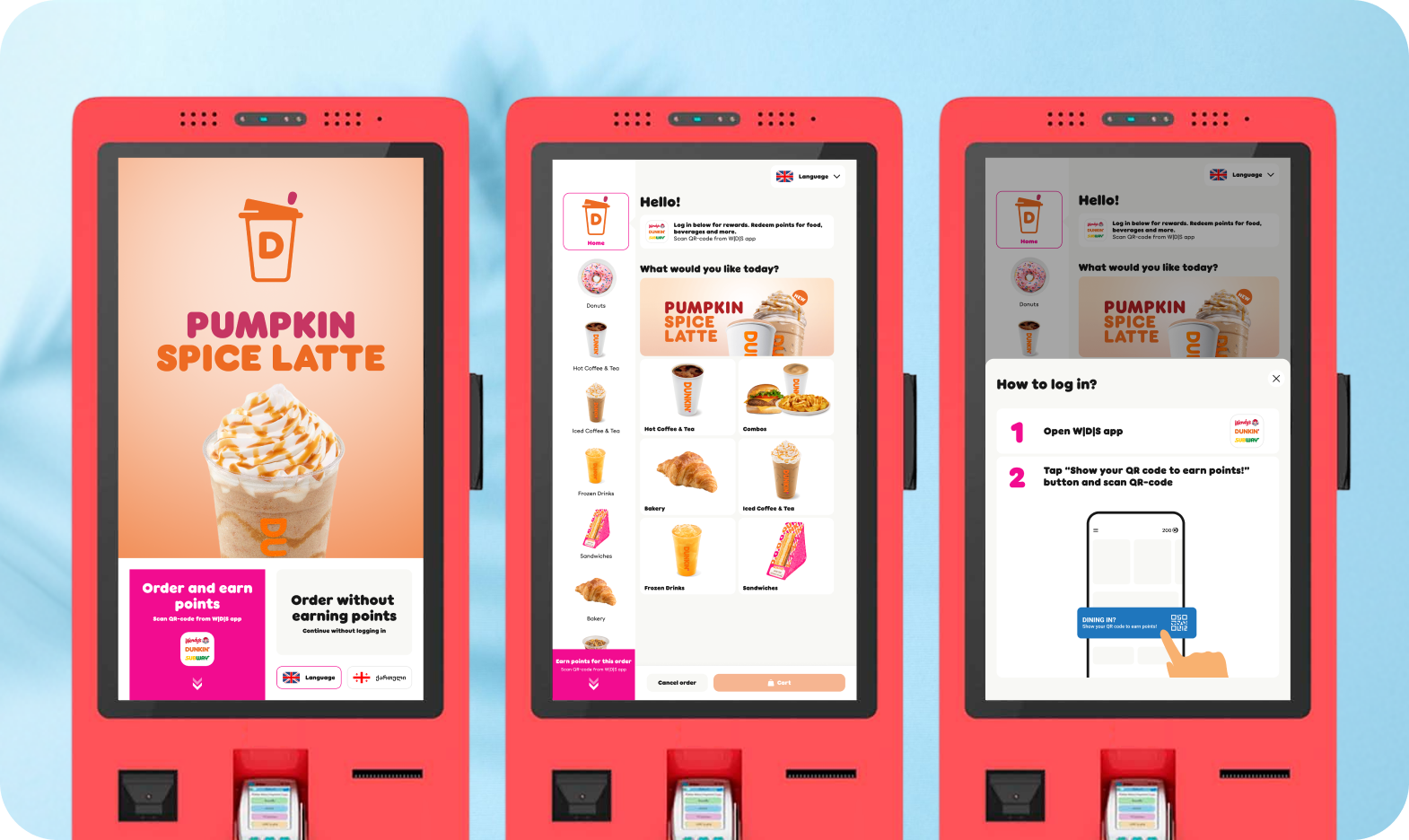
1️⃣ A new way for kiosk guests to join your loyalty program

Kiosk guests often skip loyalty because scanning a QR code before ordering adds an extra step. We built a simpler flow that allows them to join the loyalty program as part of their regular kiosk order.

Near the end of checkout, the guest enters their phone number and agrees to the program’s terms. We then create a loyalty account and immediately add the points from that order.

The guest receives an SMS with a link to install the app and claim their points. The link includes their personal reward code, which is applied automatically after installation and connects their new account to the kiosk order. If an account with the same phone number already exists, the points are simply added to it.

Business impact: Every kiosk order can become an opportunity to gain a new loyalty member without adding friction to checkout. When the guest opens the app for the first time, their points are already there.

How was Q3 at LoyaltyPlant?

2️⃣ A completely reworked way combos work behind the scenes

Combos and value bundles are some of the most common order types in QSR, but they can be complex to manage across different ordering channels and POS integrations.

We reworked the underlying combo structure so that combos can now work as a single, consistent structure across web, menu, and POS, instead of requiring separate workarounds for different connections.

The new structure has already been successfully tested with several clients and POS systems, with a full rollout planned for this fall. It also makes combo management simpler and helps ensure that combo orders are transferred correctly to the kitchen.

Business impact: Simpler combo management, fewer manual fixes when menus change, and a more reliable ordering experience for one of the most popular order types in QSR.

3️⃣ Age verification for alcohol orders

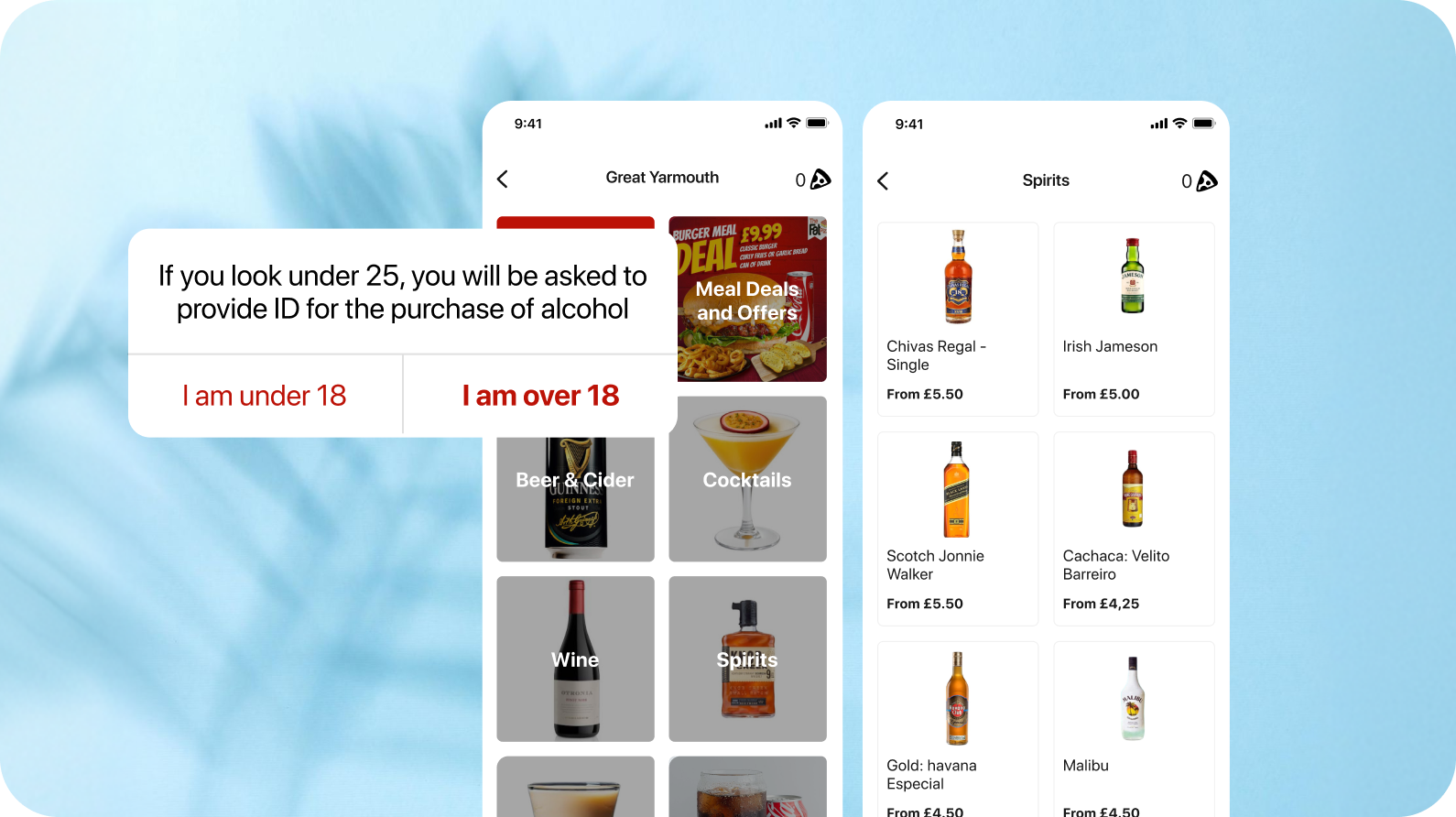
For restaurants that sell alcohol, we added an age verification step before the alcohol menu opens.

Guests who want to access the alcohol menu are asked to confirm their age, while the rest of the ordering experience remains unchanged. This helps restaurants meet local requirements in markets such as the UK without adding unnecessary steps for other guests.

Business impact: Restaurants can sell alcohol through digital ordering with age verification built directly into the customer journey.

How was Q3 at LoyaltyPlant?

4️⃣ More reliable payments and messaging worldwide

We improved the way the app handles payment errors across more global payment providers, with clearer and more consistent explanations when something goes wrong.

We also improved what happens when a bank’s fraud check blocks a payment. Instead of leaving the guest unable to complete the order, the app can automatically retry the payment with additional verification when required.

For messaging, we added support for multiple SMS providers within each market, making the delivery of one-time login codes and order updates more reliable.

Business impact: More payment issues can be recovered without interrupting the order, while login codes and order updates can reach guests more reliably across different markets.

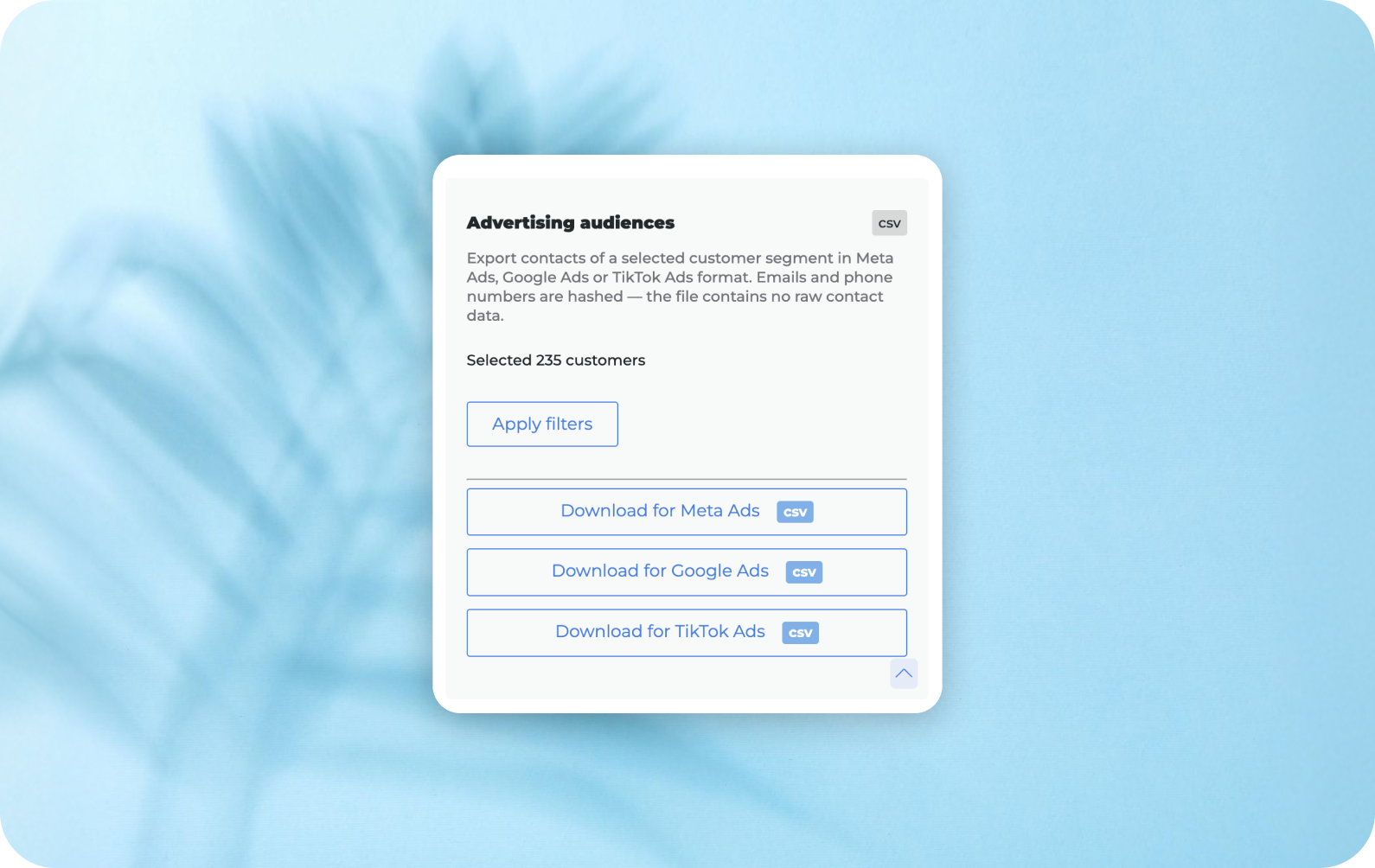
5️⃣ Turn loyalty audiences into ad campaigns in one click

Marketers can now export audiences created in LoyaltyPlant CRM as ready-to-upload files for Meta Ads, Google Ads, and TikTok Ads.

For example, if a team has already created an audience of frequent guests or lapsed customers for a loyalty campaign, they do not need to rebuild the same segment for paid advertising. They can simply choose the audience, download a file prepared for the required ad platform, and upload it to that platform’s audience tool.

Guest contact details are hashed before export, so raw personal data does not leave the CRM.

Business impact: Restaurants can use their existing loyalty data across paid marketing channels, while teams save time on audience creation and can target campaigns more precisely.

How was Q3 at LoyaltyPlant?

What this means for your team

Each update solves a different problem, but together they make the path from opening the app to placing and confirming an order faster and more reliable, while reducing manual work for restaurant teams.

Not working with us yet? 

Get a demo and see how LoyaltyPlant’s ordering and loyalty platform can work for your restaurant.

Sundae Forecast case study: how a loyalty calendar drove 10x visits

Most restaurant brands treat their restaurant loyalty app like a coupon book: a place to push a promo and hope someone notices. Sundae Ice Cream did something different. It turned its loyalty calendar into a reason to open the app every month, styled after a weather forecast, and saw app visits jump 10x on one of its busiest days of the year.

Here is how a simple, recurring idea helped Sundae strengthen restaurant app engagement without relying on another discount push and what it takes to build a restaurant loyalty program guests actually look forward to.

Sundae Forecast case study: how a loyalty calendar drove 10x visits

The problem: guests only open the restaurant loyalty app for a deal

Ice cream is a seasonal, feel-good purchase. But many loyalty programs treat every visit the same way: the same rewards page, the same generic push notification, the same “20% off today” banner. Guests get used to that pattern fast, and many restaurant loyalty apps only see a real spike in traffic around a big promotion, then go quiet again until the next one.

Sundae Ice Cream and LoyaltyPlant wanted to break that pattern. Instead of pushing bigger discounts each time, the goal was to create a restaurant loyalty strategy that gave guests a reason to check the app on a schedule, deal or no deal.

The challenge was not simply to offer more rewards. It was to create consistent customer engagement and make opening the app part of the guest experience.

The mechanic: how Sundae Forecast works

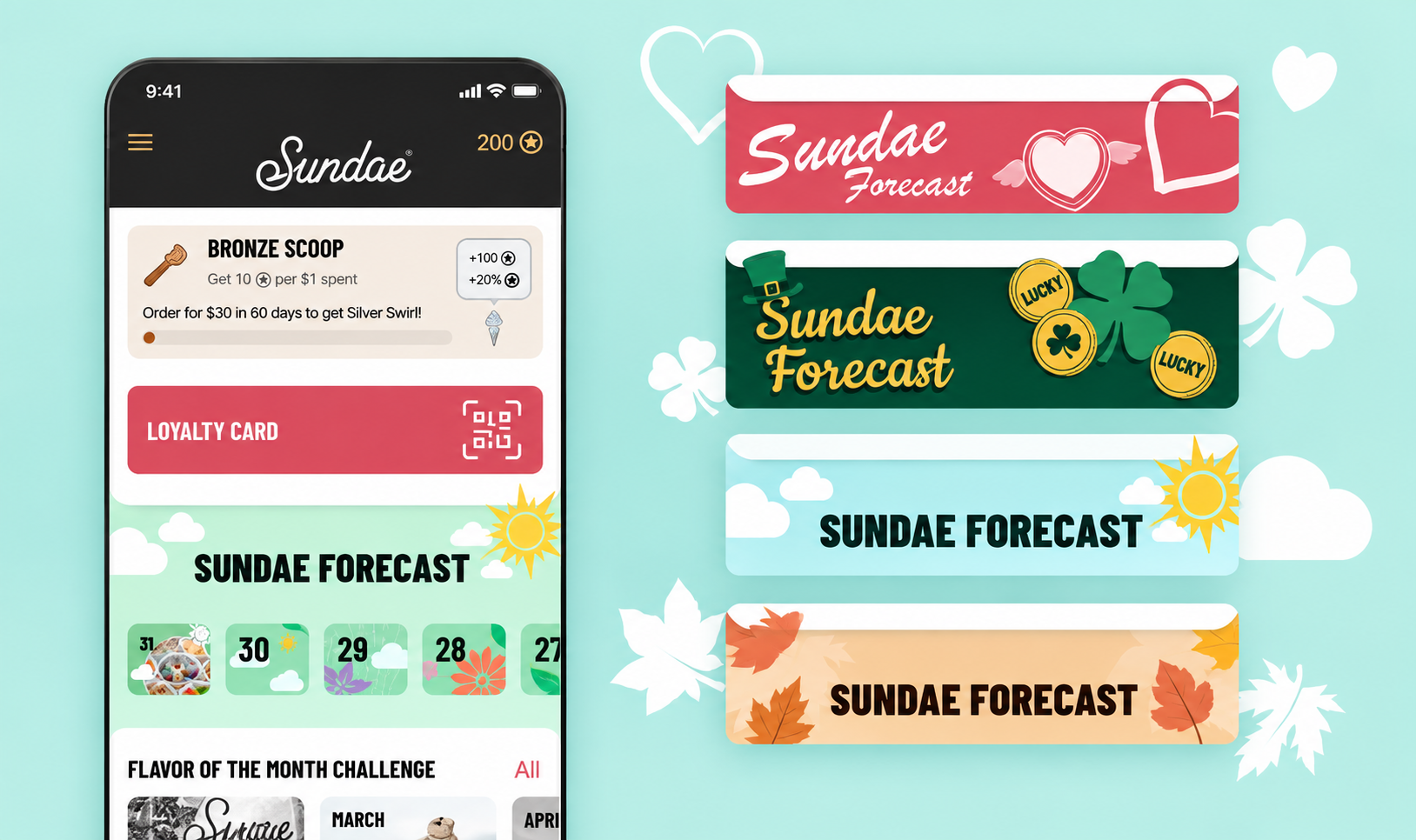
The result was Sundae Forecast, a recurring in-app experience styled after a monthly weather forecast. It uses Colorado’s famously unpredictable weather as the theme, turning a familiar local idea into a simple form of loyalty gamification.

The mechanic has four simple parts:

  • A fresh theme every month: new seasonal visuals and a new “forecast” keep the loyalty calendar feeling new, instead of like a screen guests have already stopped noticing.
  • Forecast days with real rewards: some days on the calendar unlock bonus points, free toppings, or a free scoop. Not every day, which is exactly why guests keep checking back. This makes the restaurant rewards program feel more dynamic without requiring a discount every time a guest opens the app.
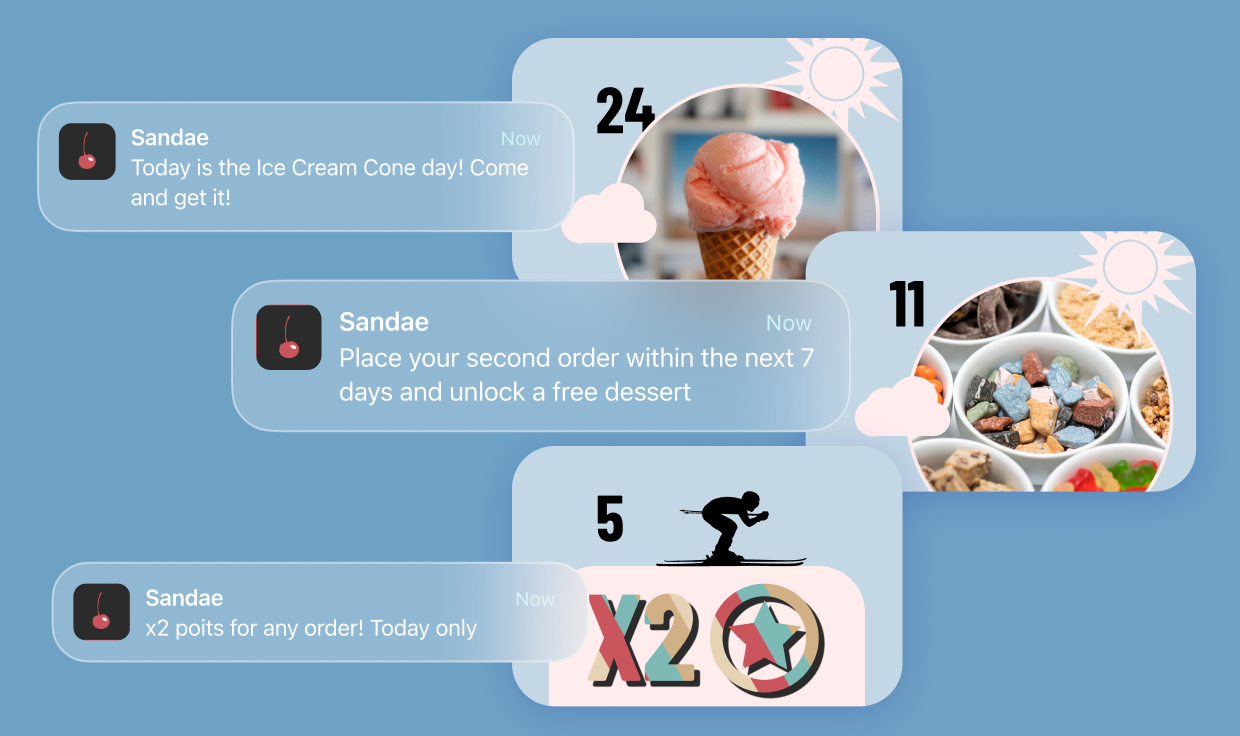
  • Two reminders, not one: guests get a nudge before a forecast day arrives, then a second one on the day itself. That way, even guests who do not open the app often still find out.
  • Open to everyone: any loyalty member can join in, whether they signed up yesterday or years ago. That matters for a seasonal brand where members join at very different times and helps make the mechanic part of the broader customer loyalty experience rather than a campaign for a small segment of users.

None of these four parts is complicated on its own. What makes Sundae Forecast work is that they repeat together, month after month, in the same simple order: new theme, anticipation, reminder, reward.

Rather than adding complexity for the sake of it, the gamified loyalty program gives guests an easy pattern to recognize and a reason to return.

Sundae Forecast case study: how a loyalty calendar drove 10x visits

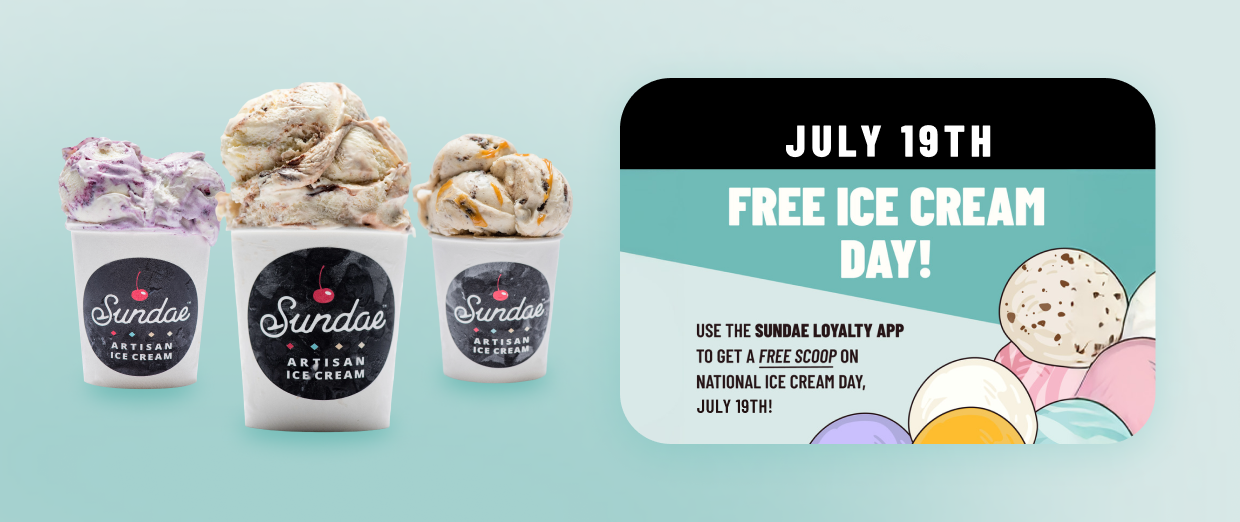
The result: 10x more app visits on National Ice Cream Day

On National Ice Cream Day, one of the brand’s biggest days of the year, app visits went up 10x compared to a normal day.

That result matters for two reasons. 

  1. First, National Ice Cream Day already gets people thinking about ice cream on its own, so a brand does not need a loyalty mechanic to spark interest that day. The 10x jump shows how Sundae Forecast helped turn that existing interest into significantly higher restaurant app engagement.
  2. Second, because the mechanic runs every month, the team did not need to build a special campaign just for that day. It was already running, and the loyalty calendar simply had a bigger reward waiting on the day guests were already excited to buy.

For the restaurant loyalty program, that means engagement is not dependent entirely on isolated promotional campaigns. The recurring mechanic gives the brand a framework it can continue using throughout the year.

Sundae Forecast case study: how a loyalty calendar drove 10x visits

“Gamified loyalty calendar” sounds clever, so it is easy to assume that is why it worked. It is not. Guests came back because the calendar was predictable, not because it was fancy.

Three simple things make it predictable:

  • A new theme every month gives guests a habit: check the app, see what is new.
  • Rewards on only some days, not every day, give guests a reason to keep checking.
  • Two reminders, not one, mean guests do not have to remember on their own. The app reminds them.
  • This is what makes loyalty gamification useful beyond simply adding games to an app. The goal is to create repeatable behaviors that strengthen customer engagement over time.


How to build a gamified loyalty calendar for your restaurant

Sundae Forecast is built around ice cream and weather, but the idea behind it works for almost any restaurant. Three questions matter more than how the calendar looks:

  1. Do you have a recurring seasonal or cultural moment to build around? Sundae Forecast works because ice cream naturally comes with seasons. If your brand does not have an obvious seasonal hook, you can build a similar mechanic around a weekly schedule instead, like a “flavor of the week” or a reward on the same day every week.
  2. Can some days be worth more than others? The mechanic works because it is not the same every day. If every day gives the same reward, guests have no reason to check back.
  3. Can you send two reminders, not just one? A single reminder on the day of an event only reaches guests who already had the brand in mind. The reminder a day or two before is what reaches everyone else.

Here is what that could look like for different types of restaurants:

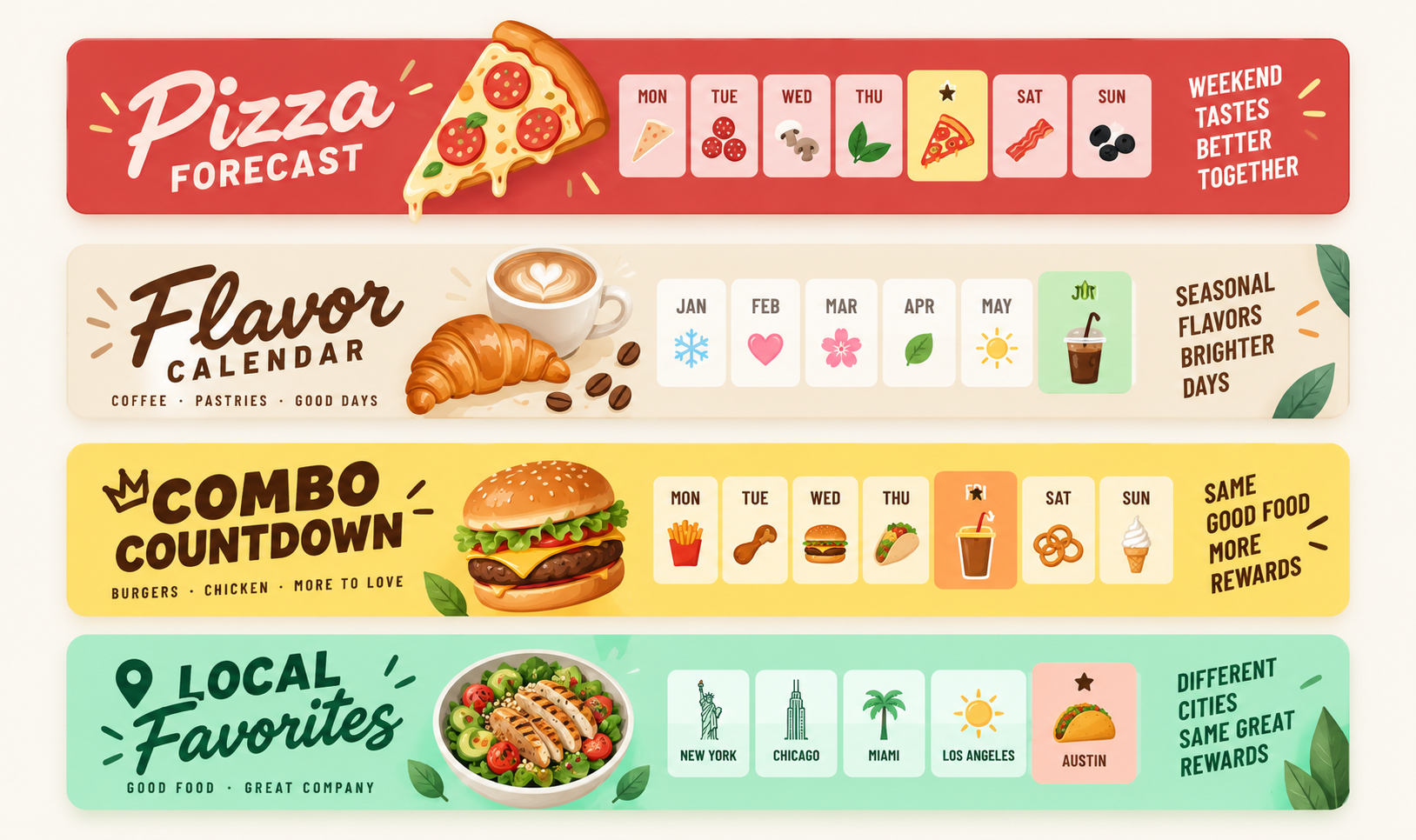
  • A pizza chain could run a “Pizza Forecast,” featuring a different topping or crust each week, with a bonus reward on a set day tied to weekend or game-day cravings instead of weather.
  • A coffee or bakery brand could build a “Flavor Calendar” around seasonal drinks or pastries, with a surprise free add-on, like an extra shot or a pastry pairing, unlocked on a few days each month.
  • A burger or chicken chain could run a weekly “Combo Countdown,” where one specific combo earns bonus points on a set day, with a reminder sent the night before, right around payday or the weekend rush.
  • A multi-location casual dining brand could tie the calendar to a rotating local menu item, so each market gets its own version of the theme while keeping the same reward structure and reminder timing everywhere.

In every version, the shape stays the same: a schedule guests can count on, a reason to check back that is not just a discount, and a second reminder that does the remembering for the guest.

Sundae Forecast case study: how a loyalty calendar drove 10x visits

The takeaway

The most useful part of this case study is not the ice cream theme. It is that the brand did not need a bigger discount to get a bigger spike. It needed a better reason for guests to check the app before the spike ever happened. That is a mechanic almost any restaurant brand can build, no matter its size or category, once the basic loop, theme, anticipation, reminder, reward, is in place.

See how a recurring loyalty mechanic like Sundae Forecast would work for your menu. Book a demo with LoyaltyPlant.

Restaurant loyalty program: 5 ways to keep guests coming back

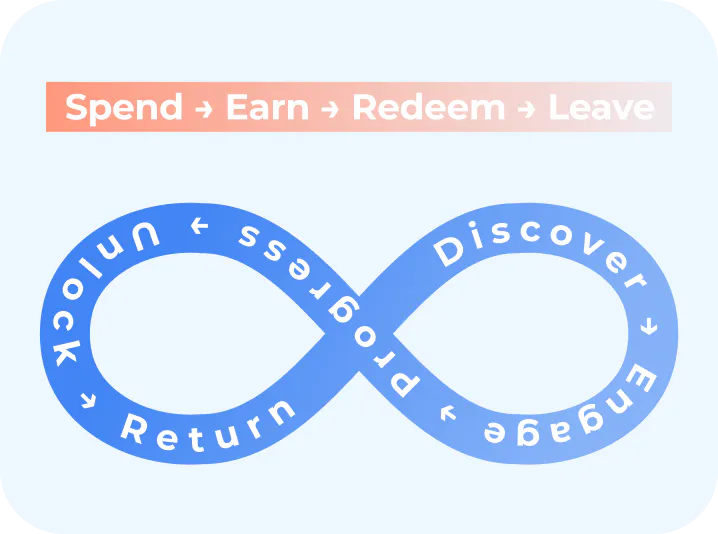
The traditional restaurant loyalty program hasn’t changed much in a decade: guests spend, earn points, and eventually redeem a reward. But points alone rarely give them a compelling reason to come back.

And that matters more than ever. Loyalty is increasingly influencing the decision before an order even happens. According to PYMNTS Intelligence, 93% of loyalty members check for deals before deciding where or what to eat, while loyalty programs influence 54% of QSR customers’ decisions.

Today’s guests expect more than delayed savings. They return when brands give them something worth returning for: progress, recognition, relevant rewards, and new experiences.

That’s why leading restaurant brands treat points as just one part of a broader engagement strategy. Modern loyalty isn’t about rewarding the last purchase. It’s about driving the next one.

Here are five loyalty mechanics increasingly replacing traditional points-only programs.

restaurant-loyalty-missions-repeat

1. Missions that guide the next action

Traditional loyalty programs reward what guests have already done. Missions encourage the behavior you want to see next.

Instead of rewarding every purchase in the same way, use missions to guide guests toward actions that support your business goals. For example, invite them to:

  • place a second order within seven days;
  • try a new menu category;
  • order through your app instead of a marketplace;
  • visit during quieter hours;
  • reach a target order value;
  • complete a series of purchases to unlock a reward.

Everyone wins. Guests know exactly what they need to do and what they’ll get in return. Restaurants can use missions to increase visit frequency, encourage product discovery, grow average order value, and drive more direct orders.

With LoyaltyPlant, missions can be triggered by products, visit frequency, order value, ordering channels, or guest behavior. As guests complete challenges, they unlock rewards, badges, new tiers, or exclusive offers. Every reward has a clear purpose, helping shape future behavior instead of simply rewarding past purchases.

restaurant-loyalty-missions-repeat-orders

2. Tiered progression that guests actually notice

A points balance tells guests what they have earned. A tiered program gives them a reason to keep going.

Visible progression can turn a restaurant loyalty program from a passive points system into an experience that gives guests a reason to keep going. 

Instead of simply seeing “640 points,” guests know they’re one step away from unlocking something new. For example, they might see:

  • one more order until Silver status;
  • €10 left before the next reward;
  • two visits needed to keep Gold benefits;
  • an exclusive reward waiting at the next level.

The best tiered programs make progress easy to understand. Guests should always know where they are, what comes next, how to get there, and what they’ll unlock when they do.

Papa Johns UAE followed this approach by combining tiered progression with personalized communication. Instead of rewarding every guest in the same way, the program encouraged customers to maintain or upgrade their status, helping grow its highest-value customer segment while improving profitability from direct digital

Restaurant loyalty program: 5 ways to keep guests coming back

3. Faster rewards build habits

One of the biggest weaknesses of a traditional restaurant loyalty program is that guests often have to wait too long before they experience any real value. If the first meaningful reward feels weeks or months away, points quickly lose their ability to motivate repeat visits.

Leading restaurant brands shorten that gap by giving guests something to look forward to early in their journey. This might include:

  • a welcome reward after joining;
  • a second-order incentive;
  • a bounce-back offer with a short expiration date;
  • a mystery prize;
  • a progress bar showing the next milestone;
  • a short-term challenge with an achievable reward.

These mechanics create momentum. Instead of asking guests to collect points indefinitely, they reward progress early and often, making each visit feel like another step toward something worthwhile.

Restaurant loyalty program: 5 ways to keep guests coming back

4. Flexible rewards create more value than cashback

Flat cashback gives every guest the same type of reward: money back on their purchase. A flexible rewards catalog gives restaurants far more options to create value without relying on deeper discounts.

Instead of offering the same reward to everyone, restaurants can tailor rewards to their brand and business goals. These might include:

  • menu items or limited-time products;
  • branded merchandise;
  • partner rewards;
  • charitable donations;
  • exclusive rewards available only to loyalty members or higher tiers.

These rewards often feel more valuable than they cost. Guests are far more likely to remember unlocking a limited-edition item or exclusive experience than earning another 5% cashback.

KFC Ukraine took this approach by moving beyond a traditional cashback model. Instead of treating points as money returned from every purchase, the program introduced a flexible rewards catalog with gamified mechanics, partner rewards, charity initiatives, and limited-time offers. The focus shifted from rewarding every transaction to giving guests more reasons to come back and engage with the brand.

Restaurant loyalty program: 5 ways to keep guests coming back

5. Recognition keeps guests engaged between purchases

Not every reward has to save guests money. Some of the strongest loyalty mechanics are built around recognition, exclusivity, and a sense of achievement.

Guests enjoy making progress, unlocking something new, or gaining access to experiences that aren’t available to everyone. These rewards create an emotional connection with the brand that discounts alone rarely achieve.

Recognition can take many forms:

  • collectible badges;
  • anniversary rewards;
  • surprise-and-delight campaigns;
  • early access to new products;
  • members-only offers;
  • limited-edition merchandise;
  • partner experiences.

Unlike cashback, these mechanics keep guests engaged between purchases. Instead of asking, “How much did I save?”, guests begin asking, “What’s next?” or “What can I unlock?”

Restaurant loyalty program: 5 ways to keep guests coming back

Is your loyalty program still built around points?

Many loyalty programs have added tiers, campaigns, or extra rewards over the years. But underneath, they still operate like cashback programs.

A simple way to evaluate your program is to ask a few questions:

  • Do guests earn rewards only by spending more?
  • Can they clearly see what they’re working toward?
  • Does the program encourage specific behaviors or simply reward completed purchases?
  • Are rewards personalized based on guest behavior?
  • Would guests still find the program interesting if discounts disappeared?

If most of these questions are difficult to answer, your loyalty program is probably rewarding transactions rather than building relationships.

Want to see what modern restaurant loyalty looks like?

Book a demo with LoyaltyPlant and discover how gamification, personalized rewards, AI-powered CRM, and flexible loyalty mechanics help restaurant brands build stronger guest relationships and increase repeat orders.

Why restaurant guests download your app once and never use it again

A guest downloads your app to claim a first-order discount, places an order, and never opens it again. Multiply that by every app download you gained last quarter, and you have a familiar problem: download numbers keep growing while repeat orders stay flat.

This is a common challenge across the restaurant industry. A study by Service Management Group, based on feedback from more than 16,000 consumers, found that 40% of respondents had deleted a restaurant app within the previous 30 days . Nearly half said they simply didn’t use it often enough. 

The challenge isn’t getting guests to install your app. It’s giving them a reason to open it again next week, next month, and beyond. Restaurant app retention is what turns app downloads into long-term growth. Here are the five most common reasons restaurant apps lose guests after their first order and what successful brands do differently.

1. Install happens outside the ordering journey

A guest who downloads your app after seeing a random ad or social media campaign often has no immediate reason to use it. The install happens separately from the ordering experience, so there’s no clear next step and no reason to come back.

Now compare that with a guest who discovers your app while already placing an order or paying for one. They’re already engaged with your brand and have an immediate opportunity to experience what the app actually makes better, whether that’s faster reordering, loyalty rewards, personalized offers, or easier payment. The app becomes part of the customer journey instead of another app competing for attention.


Fix it:

  • Make the app part of the ordering experience. Introduce it when guests are already interacting with your restaurant, such as during checkout, after payment, or when they’re waiting for their order. That’s when the value of the app is easiest to understand.
  • Use smart landing pages and the right incentive. Instead of sending every guest directly to the App Store, use a landing page that clearly explains why the app is worth downloading, then automatically directs them to the correct app store. This reduces friction, sets clear expectations, and increases the likelihood that guests will actually use the app after installing it.
  • Don’t make guests enter promo codes manually. If the reward is part of the app download campaign, apply it automatically. Every extra field or manual step increases the chance that guests abandon the process.
  • Lead with convenience, not discounts. “Skip the line,” “Order ahead,” or “Reorder in one tap” creates a reason to keep the app long after the first purchase. Discounts attract installs. Convenience builds habits.
Why restaurant guests download your app once and never use it again

2. The first order feels harder than it should

Many restaurant apps create unnecessary friction before guests can place their first order. Long registration forms, password creation, email verification, and manually entering information all slow down the moment when the guest simply wants to buy food.

The first order should feel as effortless as possible. Every piece of information you ask for should have a clear purpose in the ordering journey.

Fix it:

  • Let guests place their first order without creating a full account. A formal account doesn’t have to exist before the first purchase. Guests should be able to order immediately and start earning loyalty points from that very first transaction. The full account can be created seamlessly in the background or completed later, removing one of the biggest barriers to conversion.
  • Ask only for information that’s needed to complete the order. A phone number lets you contact the guest if there’s an issue with the order. An email address can be requested to send the receipt. Everything else can wait until later.
  • Use the device whenever possible. Let guests share their location instead of typing an address, use autofill for contact details, and support Apple Pay or Google Pay to minimize manual input.
  • Complete the profile after the order. Once guests have successfully ordered and experienced the value of your app, they’re much more willing to share additional details that help personalize future experiences.


Why restaurant guests download your app once and never use it again

3. Guests have no reason to place a second order

A points balance that doesn’t mean anything won’t hold anyone’s attention. A guest with 40 points and a guest with 400 points looking at the same rewards screen have little reason to come back and check their progress.

The problem is rarely the points themselves. It’s the absence of a clear next step. After the first order, guests should immediately understand what they can achieve next, how to get there, and why it’s worth coming back instead of ordering elsewhere.

Fix it:

  • Give every new guest an immediate reason to come back. Don’t leave them wondering what to do next after their first order. Unlock a welcome tier, offer a reward for the second visit, or give them a time-limited challenge with a meaningful prize. For example: “Place your second order within the next 7 days and unlock a free dessert,” or “Complete one more order to reach Silver status and access exclusive rewards.” The goal should feel valuable, achievable, and worth coming back for.
  • Build your loyalty program around milestones, not points. A tiered system combined with missions gives guests a clear next objective, visible progress, and a reward waiting at the finish line. Instead of watching a points balance slowly grow, they always know what they’re working toward and what they’ll unlock next.
  • Show progress in plain language. Messages like “One more order to unlock your next reward” or “You’re €8 away from Silver” are much easier to understand than simply displaying a points balance.
  • Make every milestone feel meaningful. Unlocking a new tier, receiving an exclusive reward, getting early access to a limited-time menu, or earning a personalized offer creates much stronger motivation than simply increasing a discount from 5% to 10%.
Why restaurant guests download your app once and never use it again

4. Every returning guest gets the same experience

A first-time guest and someone who orders three times a week often see exactly the same home screen: the same banner, the same “popular items,” and the same promotions.

That’s perfectly reasonable on day one, when the app knows nothing about the guest. The problem is when the experience stays generic after the second, third, or tenth order, even though the restaurant already has enough data to make it personal.

From the second visit onward, the app should start reflecting what each guest actually buys. Instead of a generic layout, the home screen should adapt based on order history, preferences, and behavior, making every visit feel faster and more relevant.

Fix it:

  • Put a guest’s favorite order on the home screen. If someone has ordered the same combo several times, replace a generic banner with a “Reorder your usual” button.
  • Personalize offers based on purchase history. By the third order, you already know enough to recommend relevant products, unlock personalized offers, or introduce loyalty rewards that match the guest’s habits instead of showing the same promotion to everyone.
  • Adapt loyalty to the guest’s behavior. Instead of one generic experience, guests can see different challenges and rewards. This makes the program feel personal and gives them a clearer reason to come back.
  • Design different home screens for different stages of the journey. New guests need help discovering the menu. Returning guests need speed, personalized recommendations, and one-tap access to what they order most often.
Why restaurant guests download your app once and never use it again

5. You notice churn only after guests are already gone

Most guests don’t disappear overnight. They gradually stop opening the app, ordering less often, and eventually fall out of the habit of engaging with your brand. Without early warning signs, restaurants usually notice the problem only when monthly or quarterly results start to decline.

The goal isn’t just to reactivate inactive guests. It’s to identify changing behavior early enough to bring them back before they’re lost.

Fix it:

  • Track changes in ordering behavior, not just active users. Watch metrics like days since the last order, declining order frequency, or missed purchasing patterns. A guest who usually orders every Friday but suddenly skips two weeks is already showing signs of churn.
  • Automate win-back campaigns before churn becomes permanent. When a guest’s ordering pattern slows down, the system should automatically trigger the right win-back campaign instead of waiting for someone on the marketing team to notice. The third visit is often the moment that determines whether a guest becomes a regular, making it an ideal opportunity for targeted re-engagement.
  • Match the incentive to the level of inactivity. A guest who hasn’t ordered for three weeks may only need a small reminder or bonus to return. Someone who has been inactive for six months may require a much stronger offer, such as a free pizza or an exclusive reward. The longer the absence, the more valuable the incentive should become.
  • Give guests an easy way to share feedback. Sometimes guests stop ordering because of a bad experience, not because they lost interest. Make it easy to leave feedback and respond quickly before dissatisfaction turns into permanent churn.
Why restaurant guests download your app once and never use it again

Downloads don’t build loyalty, habits do.

Getting guests to download your app is only the beginning. Long-term growth comes from giving them a reason to come back after the first order, again and again.

The best restaurant apps remove friction, personalize the experience, create clear reasons to return, and identify churn before guests disappear.

Ready to improve your app retention?

Book a free demo with the LoyaltyPlant team and discover practical ways to increase repeat orders, customer retention, and long-term loyalty.

Think bigger: 5 lessons from KFC Tech + Digital Summit 2026

At LoyaltyPlant, we believe that sustainable restaurant growth starts with creating experiences guests genuinely love. This philosophy was at the heart of our participation in the KFC Tech + Digital Summit 2026 in Warsaw, an inspiring event that brought together KFC franchisees, technology partners, and digital leaders from across Europe to exchange ideas and explore the future of restaurant innovation.

As an approved KFC technology vendor, we were proud to once again be part of this incredible community and contribute to conversations shaping the next generation of guest engagement.

One of the highlights of the summit for the LoyaltyPlant team was the eCommerce & Loyalty session presented by Alina Kiptyk, CEO at Tasty Food, KFC Ukraine Franchisee, and Ivan Tymko, Country IT Manager. 

It was inspiring to see how KFC Ukraine continues to invest in digital innovation, customer experience, and loyalty while operating in one of Europe’s most challenging business environments. More importantly, their story demonstrated that growth is rarely a result of favorable market conditions. 

Here are five lessons that stood out most to us from this year’s summit.

qsr industry franchaisee

Lesson #1: Don't accept market limits

Perhaps the strongest message from the summit was that market conditions do not have to define business results. 

Every restaurant brand faces challenges, from inflation and increasing competition to changing consumer behavior. Yet the most successful operators focus on what they can control: delivering better customer experiences, investing in innovation, and creating more value for their guests. 

Growth rarely belongs to brands waiting for perfect conditions. It belongs to those willing to move first, learn faster, and think bigger.

Lesson #2: Loyalty is no longer about points

Traditional loyalty programs rewarded transactions. Modern loyalty builds relationships.

Leading restaurant brands are moving beyond discounts by creating exclusive rewards, personalized experiences, and memorable moments that customers genuinely enjoy. The goal is no longer simply to drive another purchase, but to build a brand that guests actively choose, recommend, and return to because of how it makes them feel.

Think bigger: 5 lessons from KFC Tech + Digital Summit 2026

Lesson #3: Gamification creates anticipation, not just engagement

Great gamification is not just about adding games. It is about making every interaction with the brand more exciting and rewarding.

Mini-games, surprise rewards, loyalty tiers, collectibles, and exclusive content create anticipation, curiosity, and a sense of progression throughout the customer journey. Instead of simply encouraging purchases, they give customers reasons to come back, explore, and engage with the brand long after an order is placed.

Think bigger: 5 lessons from KFC Tech + Digital Summit 2026

Lesson #4 Create fans, not transactions

The strongest brands don’t just generate repeat purchases, they build communities of loyal fans.

Customers rarely talk about discounts, but they do remember experiences worth sharing. Brands that consistently surprise, delight, and recognize their guests create emotional connections that turn satisfied customers into enthusiastic advocates.

Think bigger: 5 lessons from KFC Tech + Digital Summit 2026

Lesson #5: Think ecosystems, not tools

Today’s guests expect a consistent experience wherever they interact with your brand—whether that’s your app, website, kiosk, restaurant, delivery, email, or social media.

The most successful restaurant brands connect ordering, loyalty, CRM, customer data, marketing automation, and AI into one seamless ecosystem. Instead of managing disconnected channels, they create a unified omnichannel journey that meets guests wherever they are. When every touchpoint works together, brands deliver more personalized experiences, better understand customer behavior, and build stronger long-term loyalty.

Think bigger: 5 lessons from KFC Tech + Digital Summit 2026

The KFC Tech + Digital Summit 2026 once again demonstrated the value of bringing together franchisees, technology partners, and industry leaders to exchange ideas and challenge conventional thinking.

For us, one message stood out above all others: sustainable growth is built by brands that stay focused on their guests, embrace innovation, and continue investing in the future regardless of the challenges they face today.

We would like to thank the KFC team for organizing another exceptional event and creating a platform where experiences, ideas, and best practices can be shared across the entire franchise community!

We are already looking forward to next year’s summit and to helping even more restaurant brands unlock growth through loyalty, personalization, AI, and outstanding guest experiences.

Want to turn your restaurant app into a growth machine?

Get a free business review here of your online sales channel from the LoyaltyPlant team.

Loyalty trends in QSR in 2026

The QSR industry is moving into a new phase where technology is no longer a competitive advantage but a baseline. By 2026, the global quick-service restaurant market is expected to exceed $1 trillion, fueled by digital-first customer journeys, AI-powered personalization, advanced marketing automation, and gamified loyalty mechanics that drive engagement.  

Digital channels already generate a significant share of QSR transactions, yet growth alone does not guarantee retention. A widely cited statistic highlights the challenge clearly: one in four satisfied customers never returns. This gap between satisfaction and loyalty explains why restaurants are rethinking how they engage guests beyond transactions.

In 2026, loyalty is no longer about offering discounts. It is about building a connected, intelligent ecosystem that turns data into relevance, relevance into engagement, and engagement into long-term value.

Below are five loyalty trends shaping QSR strategies today and defining who will lead tomorrow.

Loyalty trends in QSR in 2026

1. Hyper-personalization driven by behavior, not demographics

Personalization today is based on behavior, not demographics. What customers order, how often they visit, how they react to offers, and when their activity starts to decline.

In QSR, churn usually follows a clear pattern: guests visit less often, rewards stay unused, and engagement drops. These signals allow brands to act before the customer fully disengages. At LoyaltyPlant, we build personalization as a simple, structured journey based on these behavioral signals:

  • First purchase → the guest receives a tier status and visible benefits. From the very beginning, loyalty feels like progress, not just a one-time reward.
  • Status activation → if a repeat visit does not happen within the expected timeframe, automated reminders are triggered to encourage a second order and help build a habit.
  • Second purchase → the guest receives a time-limited bounceback reward to motivate another visit soon and keep the momentum going.
  • Seasonal or limited-time menu launch → offers are personalized based on what the guest usually orders. Instead of sending the same promotion to everyone, we tailor incentives to real preferences.
  • Declining activity → if visits become less frequent, the guest enters a soft winback flow with a small but relevant reward designed to bring them back without heavy discounting.

AI supports each stage by choosing the most suitable type of incentive — whether it is a product-based offer, bonus points, or a status-related benefit.

This step-by-step behavioral journey turns loyalty into a clear growth system: attract → build habit → maintain momentum → personalize → re-engage when needed.

Loyalty trends in QSR in 2026

2. Loyalty must be truly omnichannel and operationally unified

Modern QSR customers interact with brands across many touchpoints: mobile apps, websites, cashiers, kiosks, drive-thru, and aggregators. From a guest’s perspective, this is a single brand experience. From a business perspective, it often becomes a fragmented system landscape.

Loyalty breaks down quickly when data, balances, or rules differ between channels. Customers lose trust when points earned in one place are missing in another or when offers feel inconsistent.

This is why loyalty in 2026 must operate as one ecosystem, not a collection of disconnected tools.

In LoyaltyPlant, loyalty operates as a single unified ecosystem across all touchpoints. Mobile app, website, in-store cashier, self-service kiosks, drive-thru, and delivery channels follow the same loyalty logic, with consistent points, rewards, and offers everywhere.

CRM and analytics are centralized across channels, ensuring unified customer data, segmentation, and campaign rules. Integrations with POS and external services connect the entire system into one coherent structure for both online and offline interactions.

3. Loyalty evolves from transactions to emotional engagement

Transactional loyalty is easy to copy. Emotional loyalty is not.

In 2026, strong QSR brands design programs that create participation, anticipation, and habit formation. Engagement comes from progression, recognition, and unique experiences, not only from earning points.

At LoyaltyPlant, we expand loyalty beyond discounts and menu rewards. Alongside our Gamified Tiered Loyalty module and in-app lotteries, we support experiential incentives that go beyond food items. These can include exclusive stickers and limited-edition merchandise, early access to new menu launches, invitations to tasting events, or participation in product presentations.

Dynamic challenges, mini-games, and progression mechanics make loyalty interactive and repeatable, while unique rewards strengthen emotional connection with the brand.

For QSR brands, this type of engagement reduces price sensitivity, increases frequency, and builds long-term brand attachment.

Loyalty trends in QSR in 2026

4. Data and AI move from insight to execution

Data has been part of restaurant decision-making for years. What has changed is how quickly it can now be turned into action.

In 2026, advanced QSR brands use data not only to analyze the past but to shape future behavior. Predictive models, automated segmentation, and real-time campaign optimization allow teams to act immediately, not months later.

For loyalty programs, this means moving from static reports to continuous experimentation and optimization. Control groups and A/B testing allow brands to measure real uplift, compare incentive types, test timing and mechanics, and understand what truly drives incremental revenue.

LoyaltyPlant supports this shift through an AI-powered marketing engine that adapts campaign logic to user behavior and lifecycle stage in real time. Advanced segmentation, reliable control groups, flexible promotion rules, and survey-driven data enrichment allow brands to personalize offers, protect margins, and continuously improve performance, all within one platform and without slowing operations.

A strong example of this approach in action is shared in insights from the KFC Tech Summit, where LoyaltyPlant demonstrated how data-driven loyalty helps restaurants become digitally advanced market leaders.

5. Loyalty expands beyond the brand into ecosystems and partnerships

Loyalty is no longer limited to purchases inside one brand. Customers interact with restaurants through influencers, lifestyle brands, local events, and digital communities. Modern loyalty programs are starting to reflect this broader ecosystem.

For QSR brands, this means offering value beyond menu rewards. Instead of only earning and redeeming points for food, guests can engage through collaborations with other brands and communities.

Examples:

  • Redeem points for a discount at a local fitness studio or cinema
  • Earn bonus rewards during a joint campaign with a partner brand
  • Get early access to a limited menu created with an influencer
  • Participate in a city-wide promotion where several brands are connected through one loyalty mechanic

This approach increases relevance and brings new audiences into the ecosystem without relying only on discounts. The restaurant still remains the central hub where rewards, data, and communication are managed.

In this model, loyalty becomes part of a larger connected ecosystem rather than a standalone program.

Loyalty in 2026 is an ecosystem, not a feature

The future of QSR loyalty is not about offering more discounts. It is about creating systems that understand behavior, connect channels, engage emotionally, and act intelligently on data.

Brands that lead in 2026 will treat loyalty as infrastructure, not a campaign. They will build ecosystems that grow with their customers and adapt as expectations change.

LoyaltyPlant helps QSR brands do exactly that by combining personalization, omnichannel consistency, engagement mechanics, and advanced analytics into one flexible platform.

Loyalty trends in QSR in 2026

Ready to build loyalty that works in 2026?

If you are looking to transform loyalty into a real growth engine for your restaurant brand, book a demo with LoyaltyPlant and see how future-ready loyalty works in practice.

2025 in Review, 2026 Ahead: How LoyaltyPlant Is Redefining Restaurant Customer Engagement

2025 was a year of meaningful progress for LoyaltyPlant, marked by product enhancements, industry recognition, and a sharper long-term vision. Through every initiative, our focus remained consistent: helping restaurant brands strengthen guest engagement and long-term loyalty.

One of the defining product directions of the year was our deep commitment to gamification. As gamified mechanics became a clear industry trend, we invested heavily in expanding and refining this approach across our platform. In addition to our Gamified Tiered Loyalty module, we rethought in-app lotteries as a standalone engagement layer, building them around anticipation, competition, and continuous participation. Combined with dynamic challenges and mini-games, these mechanics made loyalty more interactive and habit-forming for guests. At the same time, we applied the same game logic to internal motivation programs, transforming employee engagement and performance tracking into a clear, goal-driven experience.

We also celebrated significant industry recognition together with our clients, receiving awards across key categories such as Loyalty, Customer Experience, and Gamification at prestigious platforms including Loyalty360, QSR Media Awards, and Retail ME. Following these recognitions, we were actively involved in large-scale customer and partner events across the US, Europe, and the GCC – supporting launches, sharing joint success stories, and collaborating closely with customers and partners around the globe.

In this article, we highlight the key product directions and updates already delivering stronger engagement results for restaurants worldwide, while also outlining what’s ahead. Alongside feature development, much of 2025 was dedicated to evolving our mobile app experience. To deliver a truly future-ready product – grounded in a new app UX/UI architecture, platform-native elements, and modern visual concepts such as Liquid Glass – we intentionally shifted the app release to the first half of 2026, allowing us to expand its scope and deliver a smoother, more engaging, and more cohesive experience. Further details are covered in the 2026 section below.

2025 in Review, 2026 Ahead: How LoyaltyPlant Is Redefining Restaurant Customer Engagement

Wrapping Up 2025: Key Product Highlights

Throughout 2025, LoyaltyPlant focused on several core product directions aimed at driving restaurant growth, operational efficiency, and long-term engagement.

Our key areas of focus included:

🎮 Expanding gamification as a growth driver for both guests and restaurant teams, using game mechanics to increase engagement, repeat behavior, and staff motivation

📈 Enhancing marketing and campaign capabilities with smarter targeting, automation, analytics, and tighter control over promotions and incentive budgets

💻 Simplifying CRM workflows and self-service for teams, including improved tools for analytics and reporting, marketing management and complex menu configuration

🤲 Enhancing support for end users and restaurant teams through AI-assisted automation, multilingual support, and new communication channels that scale globally

⚙️ Expanding and strengthening the integration layer across POS, kiosks, payments, and courier services, with a strong focus on stability and real-world operational reliability

🚀 Strengthening platform reliability and scalability to support a significant increase in clients and traffic volumes, ensuring readiness for continued growth at scale

Below are the key updates that delivered measurable impact on restaurant performance, guest experience, and marketing efficiency throughout the year.

1️⃣ In-App lotteries deeply integrated into the loyalty experience

We introduced in-app lotteries as a central gamification mechanic within the app. From vibrant pop-ups to real-time counters showing how many players were competing, the app created a strong sense of competition, urgency, and excitement. For brands, the goals behind launching this mechanic were clear: increase average check size, grow the number of new customers installing the app, generate PR buzz, and capture new market share in the QSR segment.

Business impact: Clients saw tangible growth across key metrics, including increased app installs, higher average order value among engaged users, and a noticeable lift in overall engagement and repeat orders.

2025 in Review, 2026 Ahead: How LoyaltyPlant Is Redefining Restaurant Customer Engagement

2️⃣ Mini-Games & Interactive challenges

Alongside lotteries, we expanded mini-games and interactive challenges as additional engagement layers within the loyalty program. This functionality enables brands to increase product awareness and support new menu launches through interactive formats that feel native to Gen Z’s digital behavior. For example, to promote new products, we introduced skill-based mini-games where users slice virtual ingredients to unlock a free menu item as a reward for completing the challenge.

With several clients, we launched calendar-based gamification mechanics – including Advent Calendar–style campaigns – rewarding users with daily incentives on each app visit. Together, these mechanics motivate users to place orders, visit more often, and interact with the app in a playful and engaging way.

Business impact: Mini-games and interactive challenges led to deeper engagement and longer app sessions, increased order frequency, and a clear shift from passive participation to active loyalty.

2025 in Review, 2026 Ahead: How LoyaltyPlant Is Redefining Restaurant Customer Engagement

3️⃣ Employee motivation & Gamified advocacy

In 2025, we extended gamification beyond end users by introducing a dedicated employee motivation system that encourages restaurant teams to actively support app adoption and sales. Game mechanics actively motivate restaurant staff to promote the app through personal referral flows, track their progress in real time, and compete via interactive leaderboards.

A frictionless new customer onboarding flow connects employee referrals directly to customer first orders, turning in-store promotion into a simple, engaging, and measurable growth channel. These capabilities are currently being tested in close collaboration with selected partners and will be rolled out progressively to more customers throughout 2026.

Business impact: the employee motivation system increased staff participation in digital initiatives, accelerated app adoption through in-store channels, and strengthened the link between employee engagement and sales performance.

2025 in Review, 2026 Ahead: How LoyaltyPlant Is Redefining Restaurant Customer Engagement

4️⃣ AI-Powered campaigns & Marketing automation

In 2025, we significantly evolved the platform’s AI-powered marketing and campaign engine, making automation smarter, more flexible, and more precise across the entire campaign lifecycle. Campaign logic now adapts more accurately to user behavior, lifecycle stage, and historical interactions, while improved audience segmentation and more reliable control groups enable clearer performance measurement and continuous optimization. 

We also introduced advanced control mechanisms for promotions, allowing brands to flexibly configure how multiple discounts, offers, and rewards can be applied within a single order – protecting margins while preserving marketing freedom. In parallel, survey-based campaigns were significantly expanded: beyond rewarding participation, surveys now enrich customer profiles with structured response data that feeds directly into CRM segmentation, personalization, and future campaign targeting.

Business impact: These improvements reduce marketing spend, increase ROMI, strengthen engagement, improve open and conversion rates, and enable more efficient, data-driven campaign execution across direct channels.

5️⃣ Analytics, reporting & data transparency

In 2025, we significantly expanded and refined the platform’s analytics and reporting capabilities, giving teams clearer visibility into performance across marketing, loyalty, and operations. Reports became faster and easier to work with, with all data available directly within a dedicated reporting section of the CRM. Built-in access controls ensure users only see data relevant to their role and assigned locations.

We added a broader set of reports covering campaign performance, best-selling menu items, and bonus credit usage, while fully tracking all manual adjustments for greater transparency and control. In parallel, we improved the control group mechanism used in campaigns, enabling more accurate performance measurement and clearer attribution of results.

Business impact: Marketers and HQ teams gain a deeper understanding of what drives revenue and engagement, can better control incentives and prevent misuse, identify top-performing employees and loyal customers, and make more confident, data-driven decisions to grow the business.

6️⃣ Operations & CRM efficiency

In 2025, we delivered a broad set of improvements focused on simplifying CRM workflows and expanding self-service capabilities for partners, franchisees, and HQ teams. These updates reduced operational complexity and made day-to-day management more efficient at scale – from campaign and analytics management to menu configuration and location control.

We also introduced automated generation of smart landing pages, promo codes, and QR codes directly within campaigns, providing full visibility into usage and performance. Together, these improvements allow teams to launch and manage direct channels faster and with less effort.

Business impact: Restaurant teams can launch and manage campaigns faster while reducing manual operational effort. Improved self-service and automation lower operational overhead and enable more consistent execution across multi-location networks.

7️⃣ Multi-brand experience

In 2025, we significantly strengthened the platform’s support for multi-brand concepts, enabling restaurant groups to operate more efficiently with multiple brands within a single app and a unified loyalty framework. This approach allows brands to maintain distinct identities while sharing common loyalty logic, campaigns, and customer data – creating a consistent experience for guests and a simpler, more scalable operational model for teams.

One example is smart location filtering across pickup, dine-in, and drive-through maps, ensuring users see only relevant restaurants based on brand and availability. Offers and campaigns are correctly tied to specific locations or brands, improving targeting accuracy and eliminating confusion across multi-brand environments.

Business impact: Guests benefit from a seamless multi-brand experience within a single app, while restaurant groups reduce operational complexity, improve campaign relevance, and scale unified loyalty programs across brands and locations.

8️⃣ Support experience & Intelligent automation

While platform reliability and operational stability remain our top priority, throughout 2025 we also continued investing in the upgrade of our support experience – for both end users and restaurant teams. Our focus has been on making support more proactive, scalable, and accessible across global markets.

We introduced and actively tested AI-assisted support workflows, including AI agents that help handle common requests, guide users through key flows, and reduce response times without sacrificing quality. At the same time, we expanded and improved communication channels, including in-app support chat for end users, making it easier to get help directly at the moment it’s needed.

Support capabilities have also become more multilingual, better reflecting the needs of our international partner base and enabling smoother collaboration with teams across different regions. These enhancements are currently being tested in close collaboration with selected partners and will be rolled out progressively to more customers throughout 2026.

Business impact: Improved support availability and consistency across markets, faster resolution time, reduced operational load on teams, and a more resilient overall experience for both guests and restaurant operators as the platform scales globally.

9️⃣ Connected restaurant ecosystem

In 2025, we continued expanding and strengthening LoyaltyPlant’s integration ecosystem, improving existing integrations and adding new ones across POS systems, self-service kiosks, payment providers, and courier services. Our focus was on real-world operational reliability – ensuring integrations remain stable, predictable, and scalable in high-load, multi-location environments.

A major area of progress was our POS integration framework. We significantly upgraded and standardized our APIs, making it easier for any POS vendor to integrate with LoyaltyPlant. With clearer documentation, improved data models, and more robust event flows, POS partners can now build and maintain integrations faster, with less custom effort and fewer edge cases.

In parallel, we reworked the API and integration flows for self-service kiosks. By introducing ready-to-use tools and clearer integration logic, kiosk vendors can now seamlessly embed LoyaltyPlant’s loyalty mechanics into their solutions – enabling unified loyalty experiences across in-app, in-store, and kiosk journeys using a single platform.

Business impact: Faster and more predictable integrations, lower integration overhead for partners, and a more resilient ecosystem that allows restaurant brands to scale digital channels without operational friction.

🔟 Continuous Improvements Across the Platform

Beyond the major product initiatives outlined above, 2025 included a large number of smaller – and not so small – improvements across the platform. These changes touched nearly every part of the system, from performance optimizations and reliability enhancements to UX refinements and operational tooling.

While many of these updates are less visible on their own, together they play a critical role in making the platform more stable, easier to operate, and better suited for real-world restaurant environments. Our focus remained consistent: helping restaurant teams work more efficiently, improving guest experience across channels, and creating a stronger foundation for sustainable sales growth.

This ongoing iteration and attention to detail allow us to continuously raise the quality of the platform – ensuring it scales reliably as our customers grow and adapt to new market demands.

Business impact: A more reliable and resilient platform, smoother daily operations for restaurant teams, and continuous improvements that support long-term growth and sales performance across diverse markets.

2025 in Review, 2026 Ahead: How LoyaltyPlant Is Redefining Restaurant Customer Engagement

What’s coming in 2026

In 2026, we’re rolling out one of the most meaningful updates in LP’s history. This is not a single feature release or a cosmetic redesign. It’s a major system-level upgrade of how the app works end to end, rethinking the most business-critical user scenarios to drive conversion, average order value, and long-term lifetime value.

While the big visual update is the most noticeable part, it’s only one layer of the work. The foundation of App 2.0 is built on clear business objectives, proven global best practices, product research, data analysis, and extensive A/B testing.

All system, UI, and UX improvements planned for 2026 are structured around five core focus areas:

  • Onboarding optimized for activation
  • Increasing frequency, engagement, and retention
  • Growing average order value
  • Reliability and post-order experience
  • Hundreds of small details that improve usability

Every feature and flow is designed to support these goals as part of one cohesive system. Below are the key architectural principles behind App 2.0.

2025 in Review, 2026 Ahead: How LoyaltyPlant Is Redefining Restaurant Customer Engagement

1️⃣ Less friction at every step

A core principle of App 2.0 is removing friction across the entire customer journey – especially at moments that most directly impact conversion.

Every screen, interaction, and decision point is intentionally simplified. From faster onboarding and smarter defaults to fewer taps, clearer choices, and reduced cognitive load, the app is designed to move customers forward instead of slowing them down.

For example, customers no longer need to remember or manually enter promo codes. Smart landings automatically activate rewards in the background. They also don’t need to create an account just to start ordering, earning points, or receiving reminders – full value and engagement are available without upfront registration.

Across the experience, unnecessary steps, interruptions, and decisions are systematically removed. The result is faster first orders, smoother repeat purchases, and fewer reasons for customers to abandon the flow.

2️⃣ Smarter logic built into everyday scenarios

In 2026, the app becomes deeply context-aware, adapting in real time to each customer’s situation.

For example, during onboarding we request location access once – not as friction, but as an enabler. This allows the app to instantly preload the nearest store menu and drop customers straight into the correct ordering experience within seconds. No loading delays, no manual store selection, no confusion. This alone significantly reduces early-session drop-off and improves first-order conversion.

Across the app, similar logic applies to how menus are surfaced, how order types are suggested, and how the experience adapts based on behavior and preferences – all in ways that feel natural and effortless to the customer.

3️⃣ AI, by design

Artificial intelligence plays a central role across App 2.0 – not as a buzzword, but as a practical engine driving performance.

During ordering, AI-powered predictive upsell suggestions adapt to each customer in real time. For first-time users, recommendations are based on proven first-order patterns across the entire user base. For returning customers, the system combines personal order history with the behavior of similar customer segments. The “Add to your order?” section surfaces small, highly relevant add-ons directly in the cart – lightweight choices with high conversion potential that increase basket value without slowing the flow.

After checkout, AI continues to work behind the scenes. Predictive order preparation and delivery timing factors in order size, item complexity, peak hours, kitchen load, and live delivery conditions. The system continuously updates ETAs using real-time data, giving customers clear, reliable expectations and reducing “where is my order?” anxiety.

AI is embedded throughout the journey – increasing conversion, growing AOV, and improving trust at scale.

2025 in Review, 2026 Ahead: How LoyaltyPlant Is Redefining Restaurant Customer Engagement

4️⃣ Gamified experience

Gamification is not a standalone feature in App 2.0 – it’s a core design principle that runs through the entire experience.

Rewards are visualized with progress bars, tier indicators, and clear goals, creating constant motivation and small “feel-good” moments. Higher-tier rewards are visually elevated through color accents and design cues, making them aspirational and desirable.

Threshold offers turn upselling into a game: customers see how close they are to unlocking free delivery, bonus points, gifts, or special tickets – with real-time updates as items are added to the cart. These mechanics are inspired by familiar patterns from online games and digital entertainment, making interactions more engaging without feeling pushy.

Animations, transitions, and feedback moments reinforce this sense of progress and achievement, keeping customers emotionally invested at every step.

2025 in Review, 2026 Ahead: How LoyaltyPlant Is Redefining Restaurant Customer Engagement

5️⃣ A bold new UI – fresher, cleaner, more powerful

The new UI brings everything together.

It’s cleaner, fresher, and more modern, with refined layouts, clearer hierarchy, smoother animations, Dark Mode, and platform-native design patterns. Hundreds of smaller improvements – from performance and accessibility to micro-interactions and visual polish – are embedded directly into this new UI layer. Together, they make the app feel faster, lighter, and more premium, while quietly doing the most important work: driving higher conversion, increasing average order value, and building long-term lifetime value over time.

2026 is shaping up to be a big year!

A year of smarter experiences, stronger results, and products that truly work for both customers and brands. We’re excited about what’s ahead – and even more excited to build it together.

Not working with us yet?

If you’re looking to launch a powerful customer engagement platform in 2026, we’d love to show you what’s possible. Get a demo.

LoyaltyPlant at the KFC Tech + Digital Summit 2025: 3 Takeaways

At LoyaltyPlant, we believe that true digital transformation in the restaurant industry starts with an engaging customer experience that drives real business growth.

That’s why we don’t just build apps or loyalty programs — we create comprehensive digital ecosystems that help restaurant brands connect with their guests in meaningful ways, navigate the fast-evolving digital landscape, and tap into our deep expertise to grow sustainably.

This philosophy was at the heart of our participation in the KFC European Tech & Digital Summit 2025, held this October in Madrid — an event that brought together numerous participants, including KFC franchisees, technology partners, and global teams from across Europe.

For us, it was an inspiring opportunity to represent LoyaltyPlant, meet our current KFC partners in person, exchange insights with key leaders, and discuss bold digital strategies to make the brand’s growth in 2026 even stronger.

LoyaltyPlant at the KFC Tech + Digital Summit 2025: 3 Takeaways

Takeaway #1: 11 herbs & spices spark customer love — our five key ingredients turn it into sustainable restaurant growth.

Global brands like KFC set the highest standards for technology, usability, and scalability. At LoyaltyPlant, we’re proud that our platform consistently meets — and often exceeds — those expectations.

Our “golden standard” product approach ensures:

  • Upsell-Focused UX
  • Omnichannel Engagement
  • Gamification & AI
  • Expert Guidance
  • Mission-Driven Team

In short, we empower our partners to focus on their business while LoyaltyPlant handles the technology, marketing, and data-driven growth behind it.


LoyaltyPlant at the KFC Tech + Digital Summit 2025: 3 Takeaways

Takeaway #2: Bringing the KFC Summit to Life with a Custom App

To make the event experience truly immersive and meaningful, LoyaltyPlant developed a dedicated KFC Summit App. Our goal was to give attendees the same sense of engagement and delight that KFC guests experience every day — turning the summit into an interactive, memorable journey rather than just a series of sessions.

The app featured the full summit agenda, venue map, and live event updates — all wrapped in the familiar UX design and gamified loyalty logic of a real KFC app. Guests could explore different sections, complete goals, unlock rewards, and even place orders, creating a hands-on experience that demonstrated how digital engagement drives customer excitement and loyalty.

LoyaltyPlant at the KFC Tech + Digital Summit 2025: 3 Takeaways


The most engaging part of the app was, of course, a game!  The Finger Lickin’ KFC mini-game was fully customized for the brand and built around a simple, addictive idea: slice real KFC dishes while avoiding the fakes like pizza, fries, and other non-KFC items. Those who completed the challenge entered to win the grand prize — an iPhone 17.

To keep the experience seamless, we used smart landing pages that guided attendees from playing the game to downloading the app and activating their rewards.

This play-to-win mini-game became a standout engagement tool, cutting through the noise and resonating especially well with Gen Z attendees.

The feedback was fantastic: attendees loved how the app brought the KFC brand to life in a fun, interactive, and innovative way.

LoyaltyPlant at the KFC Tech + Digital Summit 2025: 3 Takeaways

Takeaway #3: Strong connections and a shared vision for 2026

It was a true pleasure to meet in person both the KFC markets already powered by LoyaltyPlant and those just beginning their digital transformation journey. We exchanged ideas, discussed future goals, and strengthened our collaboration for the year ahead.

Our Founder & CEO, Vas Dichenko, took the stage with an inspiring session titled “The App That Actually Grows Your KFC Franchise: 7 Pitfalls to Avoid.”
Alina Kiptyk, CEO of KFC Ukraine Franchisee, and Ivan Tymko, Country IT Manager, presented a powerful case study on how KFC Ukraine advanced technologically this year, introducing App, Web, Kiosk, Delivery, and Loyalty — and grew from 0 to 100 in just one year.

The summit was a reminder of what’s possible when shared vision, technology, and collaboration come together — setting the stage for an even stronger 2026.

LoyaltyPlant at the KFC Tech + Digital Summit 2025: 3 Takeaways

A truly global team with one mission

Today, LoyaltyPlant is an international team of 100+ professionals in 30+ countries worldwide, united by a shared goal: helping restaurant brands achieve remarkable growth through technology and loyalty.

We’re deeply grateful to the organizers of the KFC Tech + Digital Summit 2025 for bringing together such an inspiring community of innovators. It was a privilege to take part in this event, and we’re already looking forward to next year’s summit — ready to contribute even bolder ideas to the future of KFC’s digital journey!

Want to turn your restaurant app into a growth machine?

Want to grow guest loyalty at scale without sacrificing experience?  Get here a free business review of your online sales channel from the LoyaltyPlant team.